


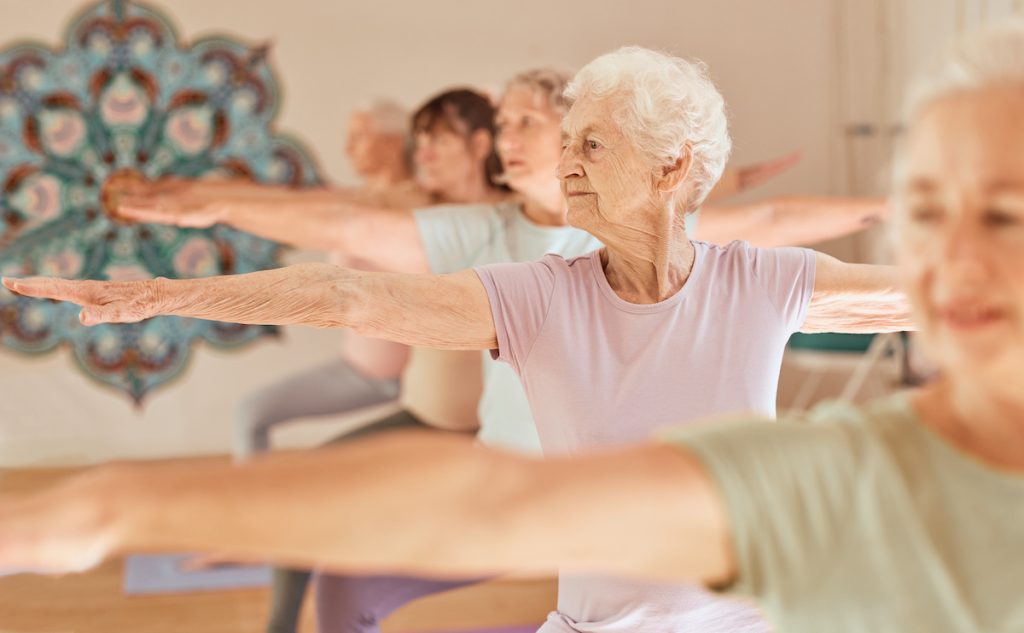
A new study has found that yoga may help prevent frailty and improve strength and gait speed in older adults who are inactive.
A systematic review of 33 randomised controlled trials (RCTs) found that yoga improved gait speed and lower extremity strength in inactive older people. However, yoga did not seem to offer a benefit for frailty markers over activities like exercise or tai chi. The review is published in Annals of Internal Medicine.
Older adults have an increased burden of chronic disease, disability, and frailty. Frailty affects up to 50 percent of adults aged 80 years and older, and its prevention and management are high priority
areas in public health and clinical practice. Yoga may be a prevention and management strategy and is already used to improve balance and mobility in older adults.
Researchers from Brigham and Women’s Hospital and Harvard Medical School reviewed 33 RCTs on 2,384 participants aged 65 years or older to evaluate the available trial evidence on the effect of yoga-based interventions on frailty in older adults.
The authors analysed impacts on frailty markers including measures of gait speed, handgrip strength, balance, lower extremity strength and endurance, and multicomponent physical performance measures.
The authors found that when compared to education-only or inactive control groups, there was moderate evidence that yoga improved gait speed and lower body strength and endurance. The benefits for balance and handgrip strength were less certain.
“When compared with education or inactive control, there was moderate-certainty evidence that yoga improved gait speed and lower-extremity strength and endurance, low-certainty evidence for balance and multicomponent physical function measures, and very low-certainty evidence for handgrip strength,” the authors state.
While there was no clear advantage for a particular style of yoga, the authors suggest clinicians may consider recommending Iyengar-based styles, with a home practice, that can be customised for older adult populations.
They conclude: “Yoga may affect frailty markers that are associated with clinically meaningful outcomes in older adult populations but may not offer benefit over active interventions (for example, exercise).”
These findings add to growing literature that yoga plays a role in healthy aging and frailty prevention.