


Engineers from the University of California San Diego have devised a cheap and simple way to check blood pressure using a smartphone.
They’ve come up with a low-cost clip that can tap into the phone’s camera and flash when used in conjunction with a special downloadable app.
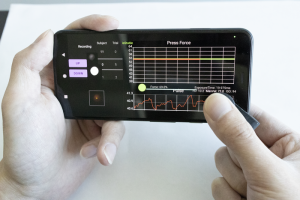
To measure their blood pressure, the user simply presses on the clip with their fingertip. The smartphone app tells them how hard and long to press during the measurement.
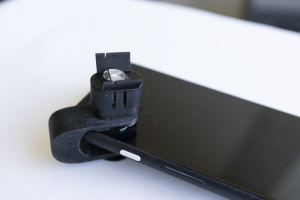
The 3-D printed plastic clip that fits over the smartphone’s camera and flash currently costs about 80 cents to make. But the team behind the innovation says the cost could be as low as 10 cents apiece if their idea is adopted and manufacturing can start on a commercial scale.
Such a device would revolutionise blood pressure monitoring, especially in impoverished and remote areas of the world where older adults and pregnant women, for example, may not have ready access to clinics or hospitals equipped with BP cuffs.
News of the technological breakthrough has been published in the peer-reviewed journal Scientific Reports.
Yinan (Tom) Xuan, study first author and an electrical and computer engineering PhD student at UC San Diego, said: “We’ve created an inexpensive solution to lower the barrier to blood pressure monitoring.”
Study senior author Edward Wang, a professor of electrical and computer engineering at UC San Diego and director of the Digital Health Lab, added: “Because of their low cost, these clips could be handed out to anyone who needs them but cannot go to a clinic regularly. A blood pressure monitoring clip could be given to you at your check-up, much like how you get a pack of floss and a toothbrush at your dental visit.”

Prototype of the blood pressure monitoring clip. Credit: Digital Health Lab/UC San Diego
A key advantage of the clip is that it does not need to be calibrated to a cuff.
Dr Wang said: “This is what distinguishes our device from other blood pressure monitors.”
Other cuffless systems being developed for smartwatches and smartphones, he explained, require obtaining a separate set of measurements with a cuff so that their models can be tuned to fit these measurements.
“Our is a calibration-free system, meaning you can just use our device without touching another blood pressure monitor to get a trustworthy blood pressure reading.”
The clip features an optical design similar to that of a pinhole camera. When the user presses on the clip, the smartphone’s flash lights up the fingertip. That light is then projected through a pinhole-sized channel to the camera as an image of a red circle.
A spring inside the clip allows the user to press with different levels of force. The harder the user presses, the bigger the red circle appears on the camera.
The smartphone app then extracts two main pieces of information from the red circle. By looking at its size, the app can measure the amount of pressure that the user’s fingertip applies. And by looking at the brightness of the circle, the app can measure the volume of blood going in and out of the fingertip.
An algorithm converts this information into systolic and diastolic blood pressure readings.
The user presses on the clip and a custom smartphone app guides them on how hard and long to press during the measurement. Credit: Digital Health Lab/UC San Diego
The researchers tested the clip on 24 volunteers from the UC San Diego Medical Centre. Results were comparable to those taken by a blood pressure cuff.
Alison Moore, study co-author, medical collaborator and chief of the Division of Geriatrics in the Department of Medicine at UC San Diego School of Medicine, said: “Using a standard blood pressure cuff can be awkward to put on correctly, and this solution has the potential to make it easier for older adults to self-monitor blood pressure.”
Checking blood pressure is one of the simplest, but one of the most important health checks. It offers a vital insight into your health.
Uncontrolled high blood pressure – or hypertension – increases with advancing age. More than half of people aged between 60-69 and around three-quarters of those 70-plus are affected.
It can lead to a stroke, heart attack, and heart and kidney failure.
Low blood pressure can be dangerous too, causing dizziness, fainting, confusion, blurred vision, nausea and vomiting, weakness and tiredness.
Lower than normal blood pressure that doesn’t cause any symptoms in an otherwise healthy person usually doesn’t require any treatment. But it can cause older adults to fall resulting in broken bones and a decline in health.
Sudden severe drops in blood pressure starve the body of oxygen, which can lead to damage of the heart, brain and other organs.
While the UC San Diego team has only proven the solution on a single smartphone model, the clip’s current design theoretically should work on other phone models.
Dr Wang and one of his lab members, Colin Barry, a co-author on the paper who is an electrical and computer engineering student at UC San Diego, have now jointly founded a company, Billion Labs Inc, to refine and commercialise the technology.
The next steps include making the technology more user friendly, especially for older adults; testing its accuracy across different skin tones; and creating a more universal design.