


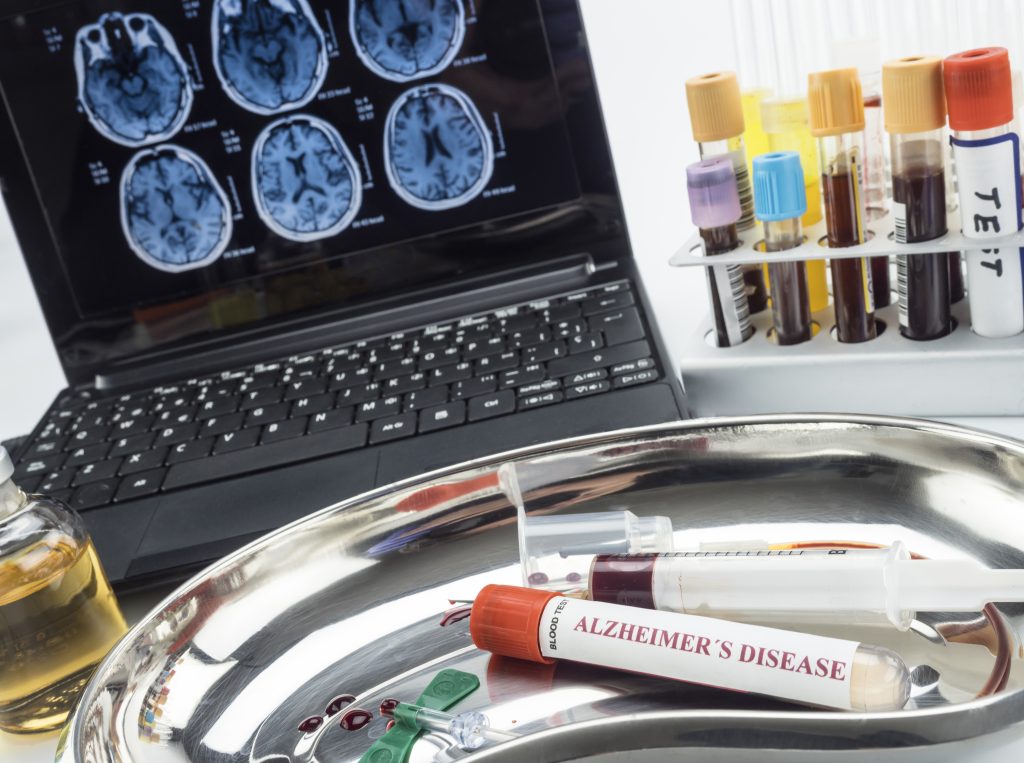
A new blood test for Alzheimer’s disease can accurately identify people with early symptoms by examining two key proteins in blood plasma.
The test, which has been approved by the US Food and Drug Administration (FDA), showed 95 per cent sensitivity in picking up people with memory problems—meaning it correctly identified the vast majority of cases with very few missed.
Researchers from the Mayo Clinic in the US tested the blood analysis on more than 500 patients at an outpatient memory clinic, providing real-world data on how well it works in a clinical setting.
The test measures two proteins—amyloid beta 42/40 and p-tau217—which are linked to the build-up of amyloid plaques in the brain, a key hallmark of Alzheimer’s.
These plaques consist of protein fragments that accumulate between nerve cells and disrupt normal brain function.
As well as its high sensitivity, the test also demonstrated 82 per cent specificity, meaning it was highly accurate in ruling out people who did not have dementia.
Dr Gregg Day, who led the study, said the blood test performed on par with more invasive tests already in use.
He said: “Our study found that blood testing affirmed the diagnosis of Alzheimer’s disease with 95 per cent sensitivity and 82 per cent specificity.
“When performed in the outpatient clinical setting, this is similar to the accuracy of cerebrospinal fluid biomarkers of the disease and is much more convenient and cost-effective.”
Cerebrospinal fluid tests require a lumbar puncture—a procedure involving a needle inserted into the lower spine to collect fluid from around the spinal cord.
The study also found that p-tau217 levels were higher in patients with Alzheimer’s than in those without the disease.
Dr Day said the next phase of research would look at how well the test performs in more diverse patient populations, including people with early-stage Alzheimer’s who do not yet show cognitive symptoms.
Dr Richard Oakley, associate director for research and innovation at the Alzheimer’s Society in the UK, said the findings “suggest this test is very accurate” and could be used alongside other assessments and clinical observations.
He added: “This study shows how blood tests are making diagnosis of Alzheimer’s disease quicker, easier and more accessible than ever before in a real-world setting.
“While focused on Alzheimer’s disease, the test was evaluated in people with other types of dementia too, showing that it may help differentiate causes of cognitive decline—though more research in diverse groups and community-based settings is still needed.
“Currently, diagnosis options in the UK are often slow, expensive and can be invasive, meaning thousands miss out on the benefits early diagnosis can bring.
“It’s great to see blood tests like this approved for clinical use in the US. We hope to see the same in the NHS, which is why we’re part of the Blood Biomarker Challenge.”
The Blood Biomarker Challenge is a multimillion-pound research programme supported by the Alzheimer’s Society, Alzheimer’s Research UK and the National Institute for Health and Care Research (NIHR).
It aims to make blood tests for dementia diagnosis available on the NHS by 2029.
Oakley added: “Blood tests will be critical to accelerate diagnosis and give more people access to the care, support and treatments they desperately need faster than ever before.
“We must see long-term investment in the tools and workforce needed to ensure everyone living with dementia can get an early and accurate diagnosis—especially with disease-modifying treatments on the horizon.”
Dr Julia Dudley, head of research at Alzheimer’s Research UK, said: “We urgently need to improve how we diagnose dementia, and it’s great to see international research working towards this goal.
“This study focused on p-tau217 and amyloid beta 42/40, and showed the tests offered high accuracy in confirming Alzheimer’s disease.
“It adds to the growing body of evidence that blood tests can detect the diseases that cause dementia in people with early memory and thinking problems.”
She added that clinical research doesn’t always reflect the diversity of people affected by dementia, who may have additional conditions or different characteristics.
“That is why more work is needed to understand whether these blood tests are effective in real-world settings.
“In the UK, studies like the Blood Biomarker Challenge are helping to build this evidence.
“The study is testing blood tests—including p-tau217—in thousands of people from sites across the country.
“This research is vital in making diagnosis easier and faster, and will help bring us closer to a cure.”