


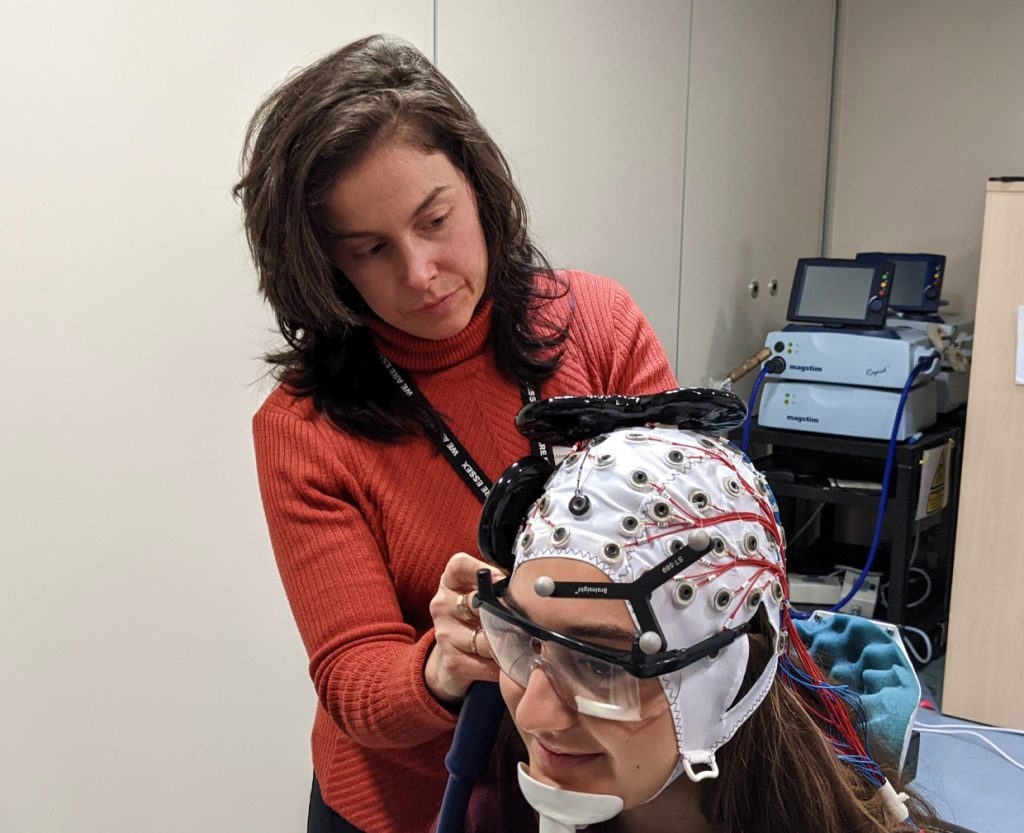
A ground-breaking discovery by a University of Essex neuroscientist could have huge implications for the treatment of stroke, dementia and motor neurone disease.
Research by Dr Alex Sel in the Department for Psychology has demonstrated that innovative brain stimulation can boost neural connectivity and strengthen communication.
The findings are published in the peer-reviewed journal, Proceedings of the National Academy of Sciences.
The researcher proved the decades-old theory for the first time by using magnets to confirm different regions are coupled and connected.
Just 15 minutes of magnetic stimulation on the brain’s movement centres can increase connectivity between them for up to three hours, the researchers found.
The researchers likened the process to ‘building broadband in the brain.’
They hope that the finding will help combat conditions that impact neural plasticity, such as stroke and dementia.
This could also halt the damage caused by some degenerative diseases, including motor neurone disease.
Dr Sal said:
“This study is a springboard for future research that we will use to investigate brain connectivity in motor areas and how this technology can be used on other parts of the brain.
“This can really pave the way for future treatments and could be a new approach to treating illnesses.
“This research has the potential to form the basis for a whole series of novel brain stimulation approaches.
“It is early days, but I am very excited by its potential.”
The researchers used the magnets on the pre-motor cortex and primary motor cortex – areas on the same hemisphere that are very close together.
After being targeted by ‘transcranial magnetic stimulation’, more than 100 volunteers were studied with an EEG which showed an increase in electrical activity between the two areas.
The treatment saw 90 per cent of participants respond positively.
Dr Sel said: “Although this might seem complicated it is best to think of this treatment as building broadband in the brain.
“The stimulation effectively increases the bandwidth between the two regions and information can move quickly between them.
“At this stage, we can’t change the size of the connections, but we can make the networks more effective.
“It is a very exciting discovery and one I hope that can help the people who really need it.”