


Howard Blackburn knows exactly why the company to which he has devoted more than 30 years of his working life, is in his opinion a game changer for those looking to keep fit in the second half of their lives.
“Because we are the only product, the only manufacturer, who has focused all of its efforts on this particular age group, the only one that has invested in understanding the needs of this age group, and we are the only one that has worked with three different universities in understanding this age group’s needs and creating a solution that delivers the right package, in the right way, in the right balance.
“So, we believe we are a game changer because we have taken up the challenge of meeting the needs of the older adult and providing the perfect solution. We believe we are a game changer because we are the only people who can do this properly and effectively. And we are absolutely confident we are a game changer because of the wonderful feedback we get.
“The magic we have is that we give people a helping hand who may have limited mobility or lack the confidence to exercise. We take away the fear of not being able to exercise and very gradually we give older people the confidence to stay fit and healthy.
“We feel proud that we are delivering the right thing, and we know the world and the market will come round to seeing this.”
The company Howard is talking about is UK-based Innerva. The Yorkshire firm bills itself as the world’s leading provider of power-assisted exercise equipment. It’s a bold claim. Innerva is by no means the only manufacturer of resistance fitness equipment.
But Howard says what makes Innerva different from its rivals is that it’s dedicated to helping the over 55s – and especially those with a range of long-term health conditions – get fit, stay fit, and age well.


Howard Blackburn, CEO of Innerva.
The 65-year-old, who has recently stepped into a new role as Innerva’s CEO after handing over the day-to-day running of the company to new managing director, Jon Hymus, says: “We are not in the market of making fit people fitter. They are already able to get to the gym and are working out. We can’t do anymore for them.
“The people we are wanting to help are those who want to get fit but maybe don’t like the thought of going to a gym because on past experience they have found the environment too intimidating, the machines too difficult to use, especially if they have mobility or health issues, and feel they don’t fit into the traditional gym scenario.
“But as people are living longer, it is vital we all try to age as healthily and actively as we can. And here at Innerva we are leading the way in providing the solutions people need to achieve that.”
Innervra works with leisure, care, rehabilitation and therapy centres across the UK, Europe and Australia, and is looking to expand into the Middle East and the US.
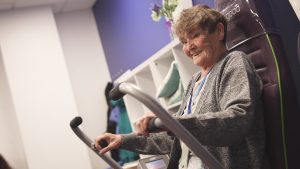
Just like any other gym equipment manufacturer, the firm offers a range of individual and circuit exercise machines targeting different areas of the body. So whether a user is looking for a full body workout or just to tone up their leg or arm muscles, Innerva has an option.
But unlike conventional exercise machines, Innerva’s range doesn’t rely exclusively on muscle power. Instead the machines are powered by an electronic system that enables users to work passively or actively, depending on their level of fitness and abilities.
All the equipment has been designed to provide safe exercise to all the major muscle groups and over time will help to retrain muscle patterns, improve circulation, and ultimately fitness.
It makes power-assisted exercise the perfect choice for older people with mobility and health issues, or for those who may just be looking to get fit after a long period of inertia.
Whilst Howard has been involved in the power-assisted exercise market since the late 1980s, Innerva is actually a new name in the field.
The company which is based near the West Yorkshire town of Holmfirth – fittingly the location of the classic BBC comedy Last of the Summer Wine centred around three elderly men reminiscing about their childhood days, and trying to stay young by engaging in madcap feats not usually undertaken by people their age – has recently undergone a name change that Howard says better reflects its unique selling point, or USP.

He says: “There was a boom in toning tables. Power-assisted exercise was the thing. At that time it was mainly boutique centres and it was like a ladies only thing.
“I joined the company and at the time I didn’t know much about business. I was just an engineer. I had never even heard of these exercise machines, but I was a confident engineer and thought I could make anything. I had always been interested in things that move, so it was like a calling for me.”
Howard rescued the company to form Shapemaster Global. As the market moved away from toning tables, the company redesigned its offering to include seated power-assisted fitness machines for the care, therapy and rehabilitation markets. It has continued to innovate and evolve over the years.
But people still associated Shapemaster with toning tables. So last year Howard changed his company’s name to Innerva. “I was looking through the planets, and spotted one called Minerva. I took the ‘M’ off it and it became Innerva. It sounded like innovate and it just sounded right.
“The V as a Roman numeral also represents the five elements of healthy ageing, those components of fitness and physical performance which are central to sustained wellbeing in older people: cardio, flexibility, balance, strength and mental wellbeing.”
To keep ahead of the game, Innerva’s products have been evaluated in numerous university-led studies.
In one recently conducted at Sheffield Hallam University’s Advanced Wellness Research Centre (AWRC), muscular, biochemical and physiological responses to power-assisted exercise amongst healthy older adults was measured. The results conclusively showed the immediate beneficial physical responses to exercising on Innerva equipment, and hence the positive impact on the five elements of healthy ageing, thus helping in maintaining and improving the quality of everyday living.
Innerva has also been the recipient of £1.1m in funding as part of the UKRI’s Healthy Ageing Challenge. The firm is now partnering with the AWRC as well as Manchester Metropolitan University to explore the challenges older adults face in accessing physical activity and how public sector leisure providers can successfully engage with the market.
Innerva will also develop new solutions that promote active ageing, giving UK leisure operators the tools to help people in their local communities remain independent and socially connected for as long as possible.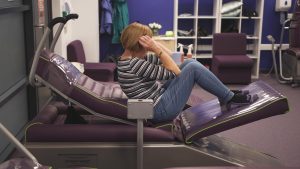
The global population is ageing. By 2035, more than half of adults in the UK are expected to be over the age of 50 and the number of people aged 85-plus is projected to double by 2050. But it’s a double-edged sword. Whilst people’s life expectancy has increased, the number of years they are living in poor health is sadly also growing.
Being physically active is one of the most effective ways to improve quality of life in later years – and help relieve the burden on overstretched health services.
“I’ve done research on what happens to people who have had a stroke, who have had a fall, and it’s quite staggering the amount of money the NHS spends on acute care, such as mending someone with a broken hip. Something like 50% of people don’t make it to year two. There are some shocking statistics. But if they do, I think the cost of a fall can be more than £60,000 to the NHS, where there is a fracture involved.
“If you look at the whole sector, falls make up more than 50% of A&E admissions in the over 60s, and the NHS spends something like £5m a day on falls, but a lot less on fall prevention. It’s the same if you look at stroke, diabetes, chronic obstructive pulmonary disease, in fact anything that comes with a measure of preventability.
“The NHS is saying that 80% of these conditions are preventable with better health, and part of that better health is from exercise.
“It didn’t take long to put two and two together to think that if someone could come up with some means of providing exercise, then if you work out what 80% of the cost of all these conditions is, it is actually £20bn. So imagine being able to save the NHS £20bn a year. The NHS costs around £200bn a year to run, so 10% is a massive amount.
“So I thought, here’s a mission, something to get my teeth into. I started to think about looking for a solution for older adults, for that age group for whom inch loss isn’t really important anymore but mobility and quality of life are.”
As he reaches retirement age himself (although he has no desire to hang up his boots just yet), Howard says his belief that everyone has the right to healthy ageing, has never been stronger. Under Jon Hymus’ leadership, Innerva will continue to partner with universities and develop and invest in new technologies and innovations to help people age better.
Howard says: “We’re now nearly three years into the United Nations Decade of Healthy Ageing, a global movement to improve the lives of older people.
“In my mind, there has never been a greater need for products and services that help people age well. Research and development is and always has been the cornerstone of this business, and going forward we will ensure Innerva remains at the forefront of innovation in the active ageing sector.”