


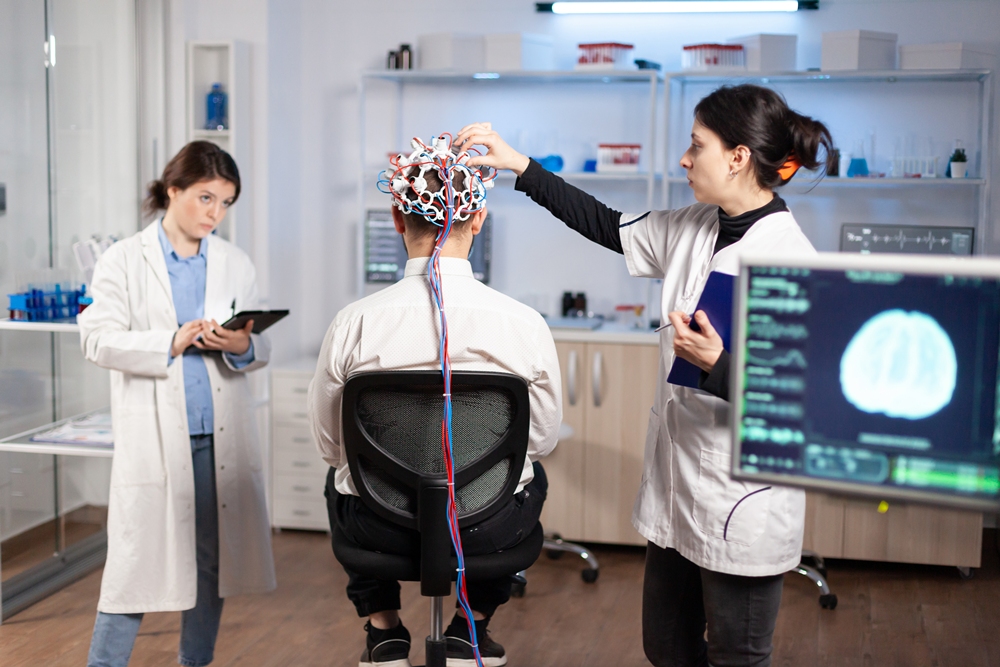
A three-minute brainwave test can detect memory problems linked to Alzheimer’s disease long before typical diagnosis, raising hopes it could identify who may benefit from new drugs.
The Fastball test uses electroencephalogram (EEG) sensors on the scalp to record electrical brain activity while people view images on a screen.
It works by analysing automatic responses to pictures seen before the test.
In a small trial with 54 healthy adults and 52 patients with mild cognitive impairment (MCI) – problems with memory, thinking or language not severe enough to stop daily activities – the test highlighted those at greater risk of developing Alzheimer’s. Larger trials are under way.
Researchers first showed participants eight images, asking them to name but not memorise them.
During testing, brain activity was recorded as hundreds of images appeared on screen for a third of a second each, with every fifth one being among the original eight.
Those with amnestic MCI, which largely affects memory for objects, showed reduced responses compared with healthy adults and those with non-amnestic MCI.
People with amnestic MCI are many times more likely to develop Alzheimer’s disease than those with non-amnestic MCI.
Dr George Stothart, a cognitive neuroscientist at the University of Bath where the test was developed, said: “This shows us that our new passive measure of memory, which we’ve built specifically for Alzheimer’s disease diagnosis, can be sensitive to those individuals at very high risk but who are not yet diagnosed.”
The test cannot say who will definitely go on to develop Alzheimer’s, but if larger studies confirm the findings, it could help doctors assess which patients are at high risk and could benefit from new drugs such as donanemab and lecanemab.
All the tests were conducted in participants’ homes, which Stothart said was important for accessibility and reducing anxiety.
Prof Vladimir Litvak of UCL’s Queen Square Institute of Neurology said it was “an early step towards developing a clinically useful test.” He added that a crucial next step would be to determine whether it can predict how a person’s condition changes over time and guide treatment decisions.
Dr Julia Dudley of Alzheimer’s Research UK said: “It’s encouraging to see studies exploring potential ways to detect memory problems earlier.
“New Alzheimer’s treatments are proving to be more effective when given at earlier stages in the disease, therefore earlier diagnosis is key for people to benefit from this.
“Longer-term studies in larger, diverse groups of people are needed to find out if this technology can predict how memory problems will unfold over time.
“Memory impairment can also be linked to other health conditions, not just dementia.
“Future research should look at how other factors may influence brainwave test results and explore how these tests could work alongside other diagnosis tools like cognitive assessments and blood tests.”