US society is currently facing a difficult trade-off between youth and experience as the baby boomer generation continues to hold disproportionate political and social sway, according to gerontocracy expert Kevin Munger.
The assistant professor of political science and social data analytics at Penn State University in the United States is featured in the latest Agetech World podcast talking about his new book, Generation Gap: Why the Baby Boomers Still Dominate American Politics and Culture.
Click here to listen to the latest Agetech World podcast
Mr Munger, whose most recent work has been delving into the world of social media and American politics, said he had been prompted to write the book in the wake of the 2016 US election and concerns about misinformation.
“When looking at this, something just really jumped out at me, which was the really dramatic difference in how much people were exposed to and shared fake news by age, where older people were much more likely to share misinformation, and this really got me down this path of thinking about the role of age and generation in a society which is very specifically right now in the middle of an information technology revolution.”

Kevin Munger
Mr Munger says American Baby Boomers – born in the post-Second World period between 1946 and 1964 – have been uniquely placed to take advantage of the new and expanding opportunities of the past 77 years, including medical advances and incredible economic growth, which now sees them possessing half of the US’s wealth in terms of pensions, equities, and property assets, accounting for more than that amassed by Generation Xers and Millennials combined.
Baby Boomers also entered politics en-masse in their 30s and 40s, making them the largest contingent in the current Congress, holding nearly one-third of the seats in the House and two-thirds of those in the Senate.
The outcome is that the US currently boasts the oldest Senate and second-oldest House – after the previous one – in its history and the second-oldest legislature in the world behind Cambodia.
Where once people were happy to retire and take a backseat, Mr Munger told Agetech World that American-born Baby Boomers now hold excessive sway both as voters and benefactors, especially in primary elections.
And their influence has not yet reached its zenith, Mr Munger suggests, with the peak concentration of what he terms ‘Boomer ballast’ set for some time in the late 2020s.
With the Baby Boomer generation controlling the political and cultural landscape, Mr Munger argues that “each new generation is less likely to turn out to vote, and I think part of the explanation of this is alienation. They don’t really feel connected to politicians, they don’t feel like anyone really represents them.
“The ability to choose between an 80-year-old and a 78-year-old (referring to current US President Joe Biden and the former incumbent, Donald Trump) is not exactly motivating to 18-year-olds who live in a very different world.”
This political malaise, he articulates, is an almost uniquely American experience.
Referring to the political and cultural landscape in Europe, Mr Munger said: “There are demographically Baby Boomers in the UK and in Germany and large other parts of Europe, but that hasn’t had the same impact on the age of politicians because of the different electoral institutions.
“So, the US with our two-party system, with our single-member district first past the post election, really gives a lot of power to incumbents and less power to parties, whereas in parliamentary systems which are proportional representation, the party has a lot more control, and so they are able to select politicians and thus prevent this kind of domination by the same older generation.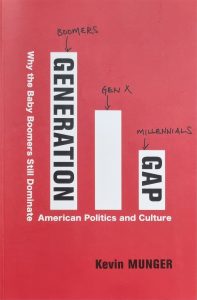
“The UK is an interesting point, however. It is kind of the middle point between the US and the rest of the European institutions. The UK actually has the third oldest legislature in the world, so they are just behind the US.
“I think that is a good point in favour of this case, because the UK is kind of a hybrid between the US institutional model and the rest of Europe.”
With the countdown to the 2024 US elections already in full swing and the country looking at potentially having to choose between current President Joe Biden and rematch challenger Donald Trump, Mr Munger’s book couldn’t be timelier.
Historically, older generations have been revered for their wisdom – with good reason, Mr Munger maintains.
Older people bring decades of knowledge and real-world experience to the table that can be passed on to the younger generation.
But with technological advances moving on apace and the older generation either failing or unwilling to keep up with these changes, Mr Munger contends this accumulated wisdom may now be out of date.
In terms of Baby Boomers’ legacy and whether history is likely to treat them kindly, Mr Munger said: “In so far as Boomers are concerned about their legacy, the thing to do is to listen to the concerns of younger generations and take them seriously.”
He added that there are difficult trade-offs between youth and experience, and that it’s important for society to be able to discuss the issue openly and fairly.
- Generation Gap: Why the Baby Boomers Still Dominate American Politics and Culture is published by Columbia University Press and is available to buy as either a hardcover or paperback from Amazon and all good bookshops. It is also available as an audiobook and Kindle edition.