News
Smartphone turned into BP monitor with cheap 80 cent clip

Engineers from the University of California San Diego have devised a cheap and simple way to check blood pressure using a smartphone.
They’ve come up with a low-cost clip that can tap into the phone’s camera and flash when used in conjunction with a special downloadable app.
To measure their blood pressure, the user simply presses on the clip with their fingertip. The smartphone app tells them how hard and long to press during the measurement.
The 3-D printed plastic clip that fits over the smartphone’s camera and flash currently costs about 80 cents to make. But the team behind the innovation says the cost could be as low as 10 cents apiece if their idea is adopted and manufacturing can start on a commercial scale.
Such a device would revolutionise blood pressure monitoring, especially in impoverished and remote areas of the world where older adults and pregnant women, for example, may not have ready access to clinics or hospitals equipped with BP cuffs.
News of the technological breakthrough has been published in the peer-reviewed journal Scientific Reports.
Yinan (Tom) Xuan, study first author and an electrical and computer engineering PhD student at UC San Diego, said: “We’ve created an inexpensive solution to lower the barrier to blood pressure monitoring.”
Study senior author Edward Wang, a professor of electrical and computer engineering at UC San Diego and director of the Digital Health Lab, added: “Because of their low cost, these clips could be handed out to anyone who needs them but cannot go to a clinic regularly. A blood pressure monitoring clip could be given to you at your check-up, much like how you get a pack of floss and a toothbrush at your dental visit.”
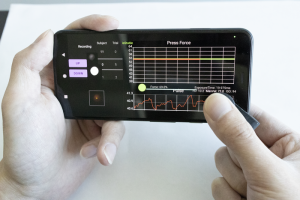
Prototype of the blood pressure monitoring clip. Credit: Digital Health Lab/UC San Diego
A key advantage of the clip is that it does not need to be calibrated to a cuff.
Dr Wang said: “This is what distinguishes our device from other blood pressure monitors.”
Other cuffless systems being developed for smartwatches and smartphones, he explained, require obtaining a separate set of measurements with a cuff so that their models can be tuned to fit these measurements.
“Our is a calibration-free system, meaning you can just use our device without touching another blood pressure monitor to get a trustworthy blood pressure reading.”
The clip features an optical design similar to that of a pinhole camera. When the user presses on the clip, the smartphone’s flash lights up the fingertip. That light is then projected through a pinhole-sized channel to the camera as an image of a red circle.
A spring inside the clip allows the user to press with different levels of force. The harder the user presses, the bigger the red circle appears on the camera.
The smartphone app then extracts two main pieces of information from the red circle. By looking at its size, the app can measure the amount of pressure that the user’s fingertip applies. And by looking at the brightness of the circle, the app can measure the volume of blood going in and out of the fingertip.
An algorithm converts this information into systolic and diastolic blood pressure readings.
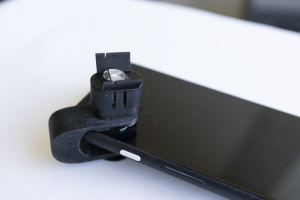
The user presses on the clip and a custom smartphone app guides them on how hard and long to press during the measurement. Credit: Digital Health Lab/UC San Diego
The researchers tested the clip on 24 volunteers from the UC San Diego Medical Centre. Results were comparable to those taken by a blood pressure cuff.
Alison Moore, study co-author, medical collaborator and chief of the Division of Geriatrics in the Department of Medicine at UC San Diego School of Medicine, said: “Using a standard blood pressure cuff can be awkward to put on correctly, and this solution has the potential to make it easier for older adults to self-monitor blood pressure.”
Checking blood pressure is one of the simplest, but one of the most important health checks. It offers a vital insight into your health.
Uncontrolled high blood pressure – or hypertension – increases with advancing age. More than half of people aged between 60-69 and around three-quarters of those 70-plus are affected.
It can lead to a stroke, heart attack, and heart and kidney failure.
Low blood pressure can be dangerous too, causing dizziness, fainting, confusion, blurred vision, nausea and vomiting, weakness and tiredness.
Lower than normal blood pressure that doesn’t cause any symptoms in an otherwise healthy person usually doesn’t require any treatment. But it can cause older adults to fall resulting in broken bones and a decline in health.
Sudden severe drops in blood pressure starve the body of oxygen, which can lead to damage of the heart, brain and other organs.
While the UC San Diego team has only proven the solution on a single smartphone model, the clip’s current design theoretically should work on other phone models.
Dr Wang and one of his lab members, Colin Barry, a co-author on the paper who is an electrical and computer engineering student at UC San Diego, have now jointly founded a company, Billion Labs Inc, to refine and commercialise the technology.
The next steps include making the technology more user friendly, especially for older adults; testing its accuracy across different skin tones; and creating a more universal design.

News
Study reveals link between cheese and dementia

A 25-year Swedish study links higher cheese intake to lower Alzheimer’s risk in people without known genetic risk, with cream also tied to lower dementia risk.
However, researchers emphasise that the results should be interpreted with caution.
The study tracked 27,670 people over 25 years.
During that time, 3,208 participants were diagnosed with dementia.
Among individuals without a known genetic risk for Alzheimer’s disease, those who consumed more than 50 grams of full-fat cheese per day showed a 13 to 17 per cent lower risk of developing Alzheimer’s.
This association did not appear in participants who carried genetic risk factors for the disease.
People who consumed more than 20 grams of full-fat cream per day also showed a lower risk of dementia overall, ranging from 16 to 24 per cent.
No meaningful links were found for low-fat or high-fat milk, fermented or non-fermented milk, or low-fat cream.
The results stand out because public health guidance has long encouraged people to choose low-fat dairy to protect heart health.
This connection matters because cardiovascular disease (conditions affecting the heart and blood vessels) and dementia share many underlying risk factors, including high blood pressure, diabetes and obesity.
When evidence from previous studies is combined, analyses suggest that cheese consumption may also be linked to a lower risk of heart disease, and that full-fat dairy does not necessarily increase cardiovascular risk.
Several other studies have explored whether similar patterns apply to brain health, but the results are mixed.
Evidence overall suggests that studies conducted in Asian populations are more likely to report benefits of dairy consumption for cognitive health (the ability to think, remember and reason), while many European studies do not.
One possible explanation is that average dairy intake tends to be much lower in Asian countries, meaning modest consumption may have different effects than higher intakes.
For example, one Japanese study reported a reduced dementia risk among people who ate cheese, but overall consumption levels were very low and the research was sponsored by a cheese producer.
In contrast, another Japanese study funded by government grants found no protective effect of cheese.
Some long-term European studies have also reported benefits.
In a Finnish study of 2,497 middle-aged men followed for 22 years, cheese was the only food associated with a lower dementia risk, reduced by 28 per cent.
Other dietary factors also appear to matter.
Higher consumption of milk and processed red meat was associated with worse performance on cognitive tests, while fish intake was linked to better results.
A large study in the UK that followed nearly 250,000 people found lower dementia risk among those who ate fish two to four times a week, fruit daily and cheese once a week.
However, these studies have important limitations.
What people eat is usually self-reported, and changes in memory can affect both eating habits and how accurately people remember what they have eaten. To deal with this, the Swedish researchers took two extra steps.
First, they excluded anyone who already had dementia when the study began.
Then they repeated the same calculations after removing people who went on to develop dementia within the first ten years of the study.
This did not mean starting the study again or recruiting new participants. It simply meant re-checking the results using a smaller group of people who remained dementia-free for longer.
The reason for doing this is that the early stages of dementia can subtly change behaviour long before diagnosis.
People may eat differently, lose appetite or struggle to recall their usual diet. By focusing on participants who stayed cognitively healthy for many years, the researchers reduced the chance that these early changes were influencing the results.
Another important question is whether substitution played a role.
Some of the apparent benefits may reflect replacing red or processed meat with cheese or cream, rather than an effect of dairy itself.
Supporting this idea, the Swedish study found no association between full-fat dairy and dementia risk among participants whose diets remained stable over five years.
Most importantly, foods should not be considered in isolation.
Dietary patterns matter more than individual ingredients. Diets such as the Mediterranean diet, which is consistently associated with lower risks of both dementia and heart disease, include cheese alongside vegetables, fish, whole grains and fruit.
In the Swedish study, people who consumed more full-fat cheese and cream were also more educated, less likely to be overweight and had lower rates of conditions linked to dementia, including heart disease, stroke, high blood pressure and diabetes.
All of these factors independently reduce dementia risk.
This suggests that higher cheese intake tended to occur within healthier overall lifestyles, rather than alongside excess calorie consumption or poor metabolic health.
Overall, the evidence does not support the idea that full-fat dairy causes dementia, nor that fermented milk products reliably protect against it.
Full-fat cheese contains several nutrients relevant to brain health, including fat-soluble vitamins A, D and K2, as well as vitamin B12, folate, iodine, zinc and selenium.
These nutrients play roles in neurological function and may help support cognitive health.
That said, the data do not justify eating large amounts of cheese or cream as protective foods against dementia or heart disease.
The most consistent message remains that balanced diets, moderation and overall lifestyle matter far more than any single item on the cheese board.
Markets & Industry
New obesity and diabetes drug set for Boots clinical trial
News
New study links Alzheimer’s memory loss to disrupted brain “replay” during rest

Memory problems in Alzheimer’s may be linked to disrupted brain replay during rest, new research suggests.
The study, conducted in mice, points to a disrupted brain process that normally helps strengthen and preserve memories.
Researchers say the findings could inform future drugs that target this malfunctioning process and guide tools for earlier detection.
Scientists at University College London (UCL) found that replay events occurred as often in mice with amyloid plaques (protein deposits linked to Alzheimer’s) as in healthy mice, but the underlying patterns were no longer organised.
Instead of reinforcing memories, the coordinated activity of place cells became scrambled.
Dr Sarah Shipley, co-lead author from UCL Cell and Developmental Biology, said: “Alzheimer’s disease is caused by the build-up of harmful proteins and plaques in the brain, leading to symptoms such as memory loss and impaired navigation, but it’s not well understood exactly how these plaques disrupt normal brain processes.
“We wanted to understand how the function of brain cells changes as the disease develops, to identify what’s driving these symptoms.
“When we rest, our brains normally replay recent experiences, this is thought to be key to how memories are formed and maintained.
“We found this replay process is disrupted in mice engineered to develop the amyloid plaques characteristic of Alzheimer’s, and this disruption is associated with how badly animals perform on memory tasks.”
This replay activity takes place in the hippocampus, a region essential for learning and memory. During rest, specific neurons known as place cells activate in rapid sequences that mirror recent experiences.
Place cells, discovered by Nobel Prize-winning UCL neuroscientist Professor John O’Keefe, are neurons that correspond to particular locations.
As a person or animal moves through a space, different place cells fire in sequence. Later, during rest, those same cells typically reactivate in the same order, helping the brain store the experience as a memory.
To study this process, researchers tested how mice performed in a simple maze while recording brain activity at the same time.
Using specialised electrodes, they monitored roughly 100 individual place cells simultaneously as the animals explored and then rested.
This approach allowed the team to compare normal replay patterns with those seen in mice that had developed amyloid pathology associated with Alzheimer’s disease.
The researchers also observed that place cells in affected mice grew less stable over time. Individual neurons stopped reliably representing the same locations, especially after rest periods, which are normally when replay should strengthen memory signals.
These changes had clear behavioural effects.
Mice with disrupted replay performed worse in the maze, frequently revisiting paths they had already explored and appearing unable to remember where they had been.
Professor Caswell Barry, co-lead author from UCL Cell and Developmental Biology, said: “We’ve uncovered a breakdown in how the brain consolidates memories, visible at the level of individual neurons.
“What’s striking is that replay events still occur, but they’ve lost their normal structure. It’s not that the brain stops trying to consolidate memories, the process itself has gone wrong.”
Professor Barry added that the findings may help researchers identify Alzheimer’s earlier or develop treatments that focus on restoring normal replay activity.
News3 weeks agoInterview: GlycanAge launch first hospital-based tests
Technology4 weeks agoCaptioning glasses win AARP pitch at CES
News4 weeks agoFood preservatives linked to increased diabetes and cancer risk, study finds
News2 weeks agoShingles vaccine may slow biological ageing in older adults
News3 weeks agoOlder male athletes may face increased risk of serious heart problems during exercise
News4 weeks agoCorsera Health raises US$80m to prevent heart disease
News3 weeks agoThousands of men in England to be offered life-extending prostate cancer drug
Technology4 weeks agoBillionaire Platt backs Engitix again with US$25m