Musical training may protect brain function in later life
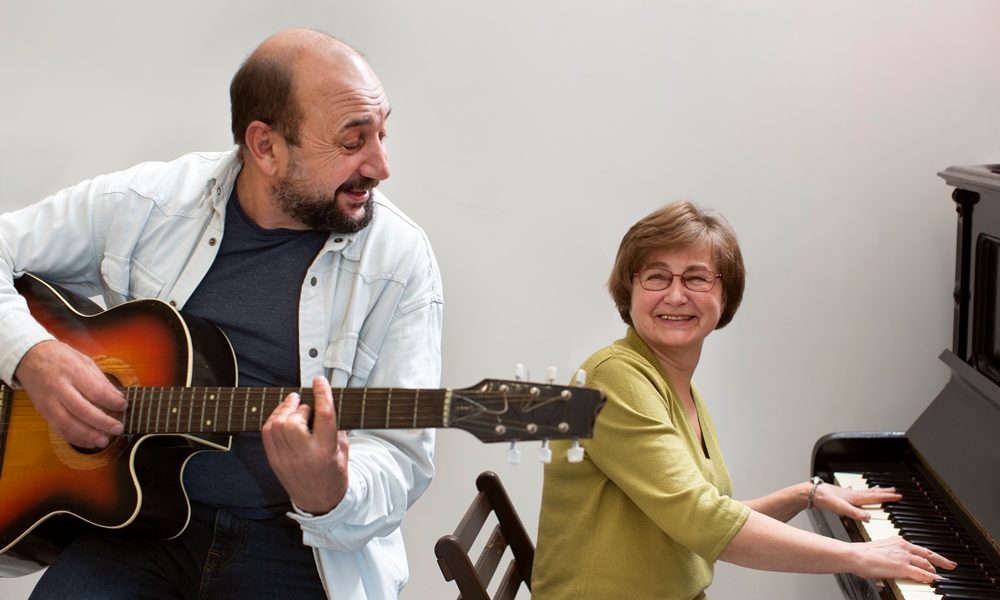
Older musicians show brain activity similar to young adults when processing speech in noisy settings, new research suggests.
Long-term musical training may reduce age-related decline in speech perception by strengthening cognitive reserve – the brain’s ability to maintain function despite changes due to ageing. This reserve may reduce the need for older adults to recruit additional neural activity to compensate during speech-in-noise tasks.
Using functional magnetic resonance imaging (fMRI), researchers scanned the brains of 25 older musicians, 25 older non-musicians and 24 young non-musicians as they identified syllables masked by background noise.
The team, from Baycrest Academy for Research and Education in Canada and the Chinese Academy of Sciences, focused on neural responses in the auditory dorsal stream – brain areas involved in sound processing and sensorimotor integration, including speech perception.
As expected, older non-musicians showed a compensatory increase in functional connectivity – heightened communication between brain regions – across both brain hemispheres. Older musicians, however, displayed connectivity patterns similar to young non-musicians. In particular, stronger connectivity in the right auditory dorsal stream was linked to better performance on the speech-in-noise task.
Older musicians also showed a more “youth-like” spatial pattern of brain activity, while older non-musicians consistently diverged from younger adults.
The results support the “Hold-Back Upregulation” hypothesis – which proposes that cognitive reserve from experiences such as musical training preserves the brain’s original functional architecture rather than relying on overactivation to compensate for decline.
“A positive lifestyle helps older adults cope better with cognitive ageing, and it is never too late to take up, and stick with, a rewarding hobby such as learning an instrument,” said Dr Lei Zhang.
“Just like a well-tuned instrument doesn’t need to be played louder to be heard, the brains of older musicians stay finely tuned thanks to years of training. Our study shows that this musical experience builds cognitive reserve, helping their brains avoid the usual age-related overexertion when trying to understand speech in noisy places,” added Dr Yi Du.
The researchers note that while the findings are promising, the study could not establish a direct cause-and-effect relationship between musical training and speech perception performance.
They suggest future research should test the “Hold-Back Upregulation” hypothesis with other cognitive tasks – such as memory or attention – and explore other sources of reserve, such as physical exercise and bilingualism, to inform interventions aimed at preserving cognitive function in ageing populations.