



King Arthur’s knights famously set out on a quest to find the Holy Grail, spurred on by the cup of Christ’s fabled healing powers and promise of eternal youth.
Fast forward 1,500 years, and we’re still pursuing the anti-ageing pot of gold.
A staggering $64bn is expected to be spent this year globally on products and services aimed at holding back the years, visibly if not necessarily physically. And that figure is predicted to grow to nearly $110bn in the next decade.
Ageing is something of an obsession of Dr Saori Kashima’s. But the environmental health expert and director of the Centre for the Planetary Health and Innovation Science (PHIS) at Hiroshima University’s IDEC Institute in Japan, isn’t interested in the latest retinol product for lines and wrinkles, botox fillers, hyaluronic moisturisers, pro-collagen serums, or any of the myriad of pharmaceutical interventions currently being developed to help modulate ageing.
She is one of a network of front-line researchers and practitioners working across disciplines who are looking to nurse the planet back to health – and in the process hopefully improve ours too.
Dr Kashima is taking on the task of discovering what healthy ageing looks like and driving the national and local actions needed to achieve it.
Her new undertaking aligns with the United Nations Decade of Healthy Ageing, a global collaboration launched in 2021 and lasting until 2030 that aims to better the lives of older people, their families, and the communities they dwell in.
Focusing on changing how we all think, feel, and act towards growing older, it’s hoped that by the end of the decade more age-friendly environments will have been cultivated; better integrated and responsive health care systems and services created; and that those who need it will have access to the right kind of long-term care offering the support required to live with dignity, meaning and rights.
It is being hailed by the UN as an unprecedented opportunity for people across the spectrum to come together to find the solutions essential for people to lead a meaningful life as they age.


Dr Saori Kashima
And Dr Kashima is playing her part by turning to planetary health science for guidance.
As she says: “Without the health of the planet, it is hopeless to achieve ‘healthy ageing’ in the future.”
To understand her thinking, it is necessary to turn the clock back to earlier this year. Days before the G7 Hiroshima Summit in May, scholars delivered a call to act on the planet’s health.
This was fittingly undertaken at the Hiroshima Peace Memorial Park, a monument dedicated to the estimated 140,000 people killed when the United States launched the world’s first atomic attack on the city on Japan’s Honshu Island on August 6, 1945, at the end of World War Two.
It was this apocalyptic event and the subsequent detonation of a second atomic bomb three days later over the city of Nagasaki on the Japanese island of Kyushu, that prompted one of the most influential scientists of the 20th Century, Albert Einstein, to utter in 1946 his oft-quoted plea for humanity’s survival: “…a new type of thinking is essential if mankind is to survive and move toward higher levels.”
Three-quarters of a century on, with human activity having breached seven of the eight boundaries (which include water availability, land use change, ozone depletion, and climate change), ensuring Earth’s safety, academics are making a similar appeal.
Writing in the Hiroshima Planetary Health Declaration 2023, they said: “We are now facing a ‘Great Transition’ in tackling various global issues, such as climate change, biodiversity loss, environmental pollution, and conflicts.
“Educational and academic institutes are required to take on the challenge of new scientific approaches that go beyond existing ordinary thinking.”
Nine years ago, the new science of planetary health was born to do just that; to begin seeing our interconnectedness with nature through collaboration.
Just how important it is that the currently ailing world we rely on is returned to fitness, has been eloquently summed up by Dr Maria Neira, director of the Department of Public Health and Environment at the World Health Organisation. She has said: “Every day we depend on biodiversity (the sheer variety of life found on Earth) to keep us alive and healthy. The air we breathe, the water we drink, the foods we eat and the medications we take are all by-products of a healthy planet.
“But our world, and the diversity of life it supports, is under threat. Deforestation, pollution, greenhouse gas emissions, draining of wetlands, climate change, globalization and other factors of modern life are wiping out species and damaging ecosystems at unprecedented rates.
“When we damage the Earth, we damage our own health. Human beings are as susceptible as any other species.”
Leading the way in this growing scientific field is Dr Kashima. She told Agetech World: “Many factors are intertwined and connected. I think that people have to recognise the connection more. This does not occur only within one country but across borders.
“Our daily life is connected to people’s lives in African countries and other areas.”
Dr Kashima, who has worked with the health ministries in Senegal and Madagascar as a Japan International Cooperation Agency volunteer, added: “For tackling climate change, the current reductionist or siloed approaches are not providing enough solutions.”
Global statistics show that the number of countries where a fifth of the population is aged over 70 is continuing to grow.
Japan’s ‘super-ageing’ society ranks as the oldest in the world, with data released in September 2022 revealing the number of over-75s has now risen to 19.37 million – more than 15% of the country’s population.
The number of over-65s has also increased to 36.27 million – 29.1% of the nation’s people.
This puts Japan well ahead of the second-placed country, Italy, on 24.1%, when it comes to having the oldest society by proportion of over-65s. In third place is Finland on 23.3%.
But while the average life span in 2020 had risen by nearly three decades to 73 compared to just 47 in 1950, people’s health span, which refers to the number of years we can expect to live in reasonably good physical condition, has lagged way behind.
Environmental pollution and climate change-fuelled extreme weather are known to unequally disadvantage the vulnerable, which includes older people.
This is a problem that Dr Kashima understands well.
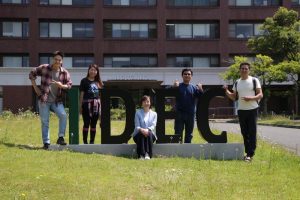
Dr Saori Kashima (centre) with her students at Hiroshima University’s Centre for the Planetary Health and Innovation Science
In 2022 she co-authored a study on the impact of the 2018 floods in western Japan, the most severe recent water-related disaster to hit the nation, which killed 237 people, injured another 433, and destroyed nearly 7,000 houses.
Many of the deaths were among vulnerable older people.
The study’s findings also showed how calamities are a potential risk factor for dementia in the elderly.
In another study, Dr Kashima and her co-researchers found that natural disasters increase the likelihood of nursing home admissions. In the conclusion, they urged policymakers to prepare for this emerging risk factor.
Now Dr Kashima and her PHIS colleagues from the fields of science, engineering, and agriculture, among others, are working with community and government partners to develop a Planetary Healthy Ageing Index (PHAI).
It will serve as a community-orientated guide to measure, monitor, and evaluate progress in attaining healthy ageing for both the planet and the eight billion-plus people who call it home.
She said: “Japan’s traditional culture is nature worship such as ‘satochi’, ‘satoyama’, and ‘satoumi.’ Recognising these traditions passed down to children and grandchildren is also one of the practical approaches to planetary health.”
Satochi, satoyama, and satoumi are portmanteaus that pair the Japanese words for earth (chi), mountain (yama), and sea (umi) with village (sato).
These are spaces embodying the harmonious co-existence of human societies and nature.
“We hope that while developing the PHAI with the community, existing solutions like this will be reaffirmed. Such local solutions exist not only in Japan but also in other countries and regions,” she explained.
Dr Kashima wants countries to adopt an index like PHAI that incorporates Earth’s health into their agenda.
She said: “Even if we develop local policies and actions considering human health…people need a fundamental shift, a great transition, in how we live on Earth.”