Connect with us

News

The robot companion that could soon be helping older people age better
Published

on

A cargo-carrying robot that follows you around could be the answer to promoting healthy ageing.

Research carried out by Newcastle University in the UK has shown the gita robot (pronounced jee-ta and spelt with a lowercase ‘g’) can support the mobility and wellbeing of older people.

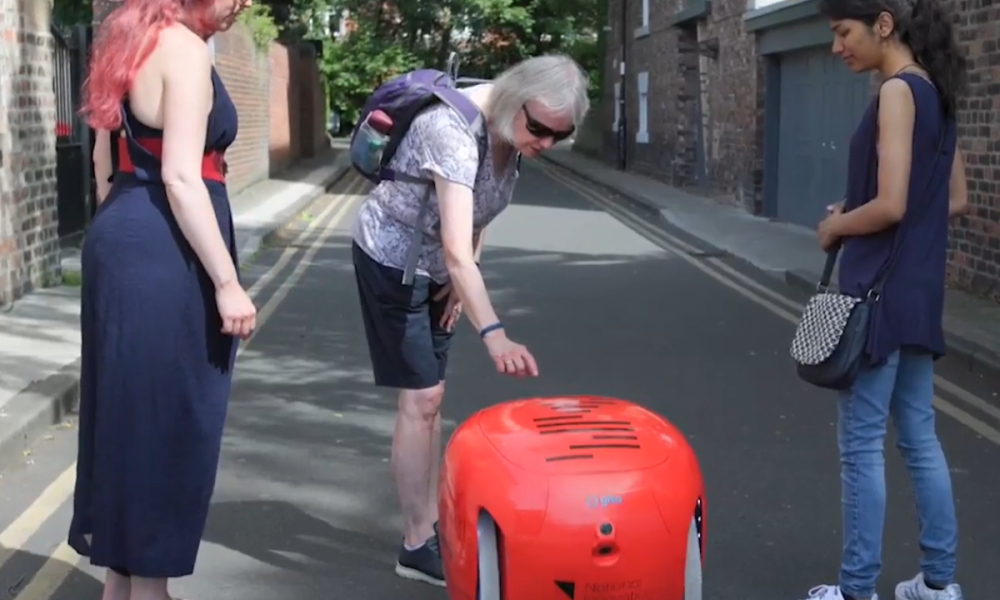
The findings of the world-first citizen-led study have revealed gita – which looks like an over-sized medicine ball on wheels and has been designed to follow humans – has the potential to help alleviate loneliness in independent older people by prompting conversations and social interaction, as well as encouraging walking, and fostering independence and more sustainable living.

Dr Shuo Li, a research associate at Newcastle University’s School of Engineering, and lead author of the study, said it “demonstrates how future mobility and robotic innovations have the potential to address the global challenge of ageing.”

Designed by Boston-based robotics company Piaggio Fast Forward and backed by the Piaggio Group – the makers of the iconic Vespa scooter – gita was launched onto the US market in 2019 to help make everyday life easier, smarter, and more fun for humans of all ages.

Its sole purpose is to follow people wherever they go. Moving at a speed of up to six miles an hour and able to carry a load of 18kg in its internal cargo compartment, gita communicates through sound, light, touch and 360-degree vision.

Whilst gita can’t climb stairs, it can move around buildings with lifts and ramps as well as hard surfaces like pavements.

With one in six of the world’s population predicted to be aged over 65 by 2050 and growing numbers of older people needing care, the team at Newcastle University spotted the potential for gita robots to help foster more independent and sustainable living, as well as potentially lessening the effects of loneliness and isolation.

The researchers showed videos of an older adult interacting with the gita robot in a real-world setting to a group of study participants with an average age of 75, and analysed their feedback and requirements.

They indicated that the robot would physically support them when out for a walk, removing the need to carry things like groceries, and even acting as a seat. Several participants also suggested the robot could be useful for carrying items to help support them whilst out for a walk.

According to the Newcastle University team the results have also shown that gita can facilitate social interactions, such as gaining potential attention and acting as a talking point to help kickstart conversations.

A gita robot being trialled in Newcastle in the UK

Other aspects the researchers investigated included the perceived benefits for others in the community, any issues of the human-following robots, and requirements for improvements.

Many of the participants suggested they did not yet need the support of a human-following robot, given that they could still carry belongings or drive, but indicated it could be useful for maintaining their mobility and independence if their health were to decline or their circumstances changed in the future.

Follow-up research is now underway to examine and quantify older adults’ interaction with a human-following robot in a real-world context.

The study has been published in the journal Nature Scientific Reports and is based on final-year research undertaken by former Master of Engineering (Meng) student, Kirsty Milligan, who was supervised by Professor Phil Blythe and Dr Shuo Li.

The civil engineering graduate said: “My research project was a valuable opportunity for me to try something a bit different as part of the final year of my MEng degree, and it was really interesting to explore whether such an innovative technology has the potential to support active ageing.

“I enjoyed talking to the participants and hearing their thoughts on the robot, as well as learning more about research methods and qualitative data analysis.

“It is really exciting that a paper based on my work has been published, and I hope it inspires others to further explore the use of these types of technologies by older people.

“I’ll be interested to see where future research in this area goes, and if maybe we will see these types of robots in everyday use one day.”

The gita robots are being tested by the team at the National Innovation Centre for Ageing (NICA) on Tyneside, a world-leading organisation supported by an initial investment from the UK government and Newcastle University, which is looking at ways of co-developing and bringing to market products and services to create an environment in which people can live better for longer.
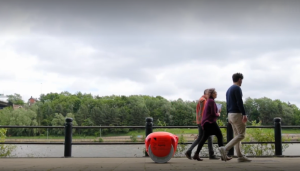
Gita will follow behind and can carry up to 18kg of belongings

NICA’s director and one of the study’s co-authors is Professor Nic Palmarini. He said: “This is an example of how emerging technologies can help tackle and mitigate isolation and support older adults’ engagement in outdoor activities, a crucial driver to population’s health and longevity.

“This is a great example of what we have defined as ‘ageing Intelligence’ at work and is part of our wider research on supporting mobility for our older citizens.”

Phil Blythe, professor of Intelligent Transport Systems, and head of the Future Mobility Group at Newcastle University, who also co-authored the study, added: “We believe that research into supporting the mobility of older people and ensuring they have transport systems and services that are fit for purpose is critical for a fair and levelled up society.

“This is one of the key areas of my group’s research where we are always looking for future technologies that can improve the mobility of all.”

The researchers argue that while these robots offer advantages, there is a need for additional improvements to their design to fully support older people.

They say it is crucial to take into account the needs and demands of older individuals when creating and advancing age-friendly robots that can follow humans.

Limitations highlighted in the study include the possible negative interactions between the robot and others. The researchers suggest considering future iterations of the robot that address these concerns, such as implementing a security system that connects to a remote operator.

According to the study’s results, robot developers and innovators must focus on improving the robots’ ability to navigate kerbs, steps, and diverse terrain for them to be practical for most elderly people.


Research

Mole rat gene extends mouse lifespan

Published

on

A mole rat gene inserted into mice extended lifespan and improved health, findings that may point to new ways of supporting healthier ageing.

The gene increased production of a large form of hyaluronan, a naturally occurring gel-like substance between cells that helps tissue repair and cell-to-cell communication.

Mice carrying the naked mole rat version of the gene showed an approximately 4.4 per cent increase in median lifespan, alongside multiple markers of healthier ageing.

Naked mole rats have become a focus of ageing research because they combine an exceptional lifespan with unusual resistance to many age-linked diseases, including cancer.

Researchers at the University of Rochester traced part of that resilience to hyaluronan.

The molecule’s effects depend on its size: large forms are often linked to anti-inflammatory and tissue-protective behaviour, while smaller fragments can act as danger signals that increase inflammation.

Vera Gorbunova, professor of biology and medicine at the University of Rochester in the US, said: “Our study provides a proof of principle that unique longevity mechanisms that evolved in long-lived mammalian species can be exported to improve the lifespans of other mammals.”

The engineered mice were better protected against both spontaneous tumours and chemically induced skin cancer.

They also showed reduced inflammation across tissues, a notable finding because persistent low-grade inflammation, sometimes called inflammaging, is widely seen as one of the central drivers of age-related decline.

The research also linked the large form of hyaluronan to age-related gut health. As animals age, the gut barrier can become leakier, allowing inflammatory triggers to pass into the bloodstream.

The engineered mice showed protection against this deterioration.

Follow-up work found abundant high-molecular-mass hyaluronan across multiple species of subterranean mammals, often absent in closely related above-ground species, suggesting it may be part of a broader evolutionary toolkit for surviving long lives under harsh conditions.

The team said gene transfer is not the end goal. Gorbunova said: “It took us 10 years from the discovery of HMW-HA in the naked mole rat to showing that HMW-HA improves health in mice.”

“Our next goal is to transfer this benefit to humans.”

Two practical routes are being pursued: increasing production of the large form of hyaluronan, or slowing its breakdown.

Andrei Seluanov, who co-leads the research, said: “We already have identified molecules that slow down hyaluronan degradation and are testing them in pre-clinical trials.”

One candidate identified through screening is delphinidin, a plant pigment found in various fruits and vegetables.

In tests, it was found to increase levels of the large form of hyaluronan in cells and mouse tissues, reduce migration and invasion in multiple cancer cell lines, and suppress melanoma metastasis in mice.

However, the researchers acknowledged the approach has limits. A later study found that mice expressing the naked mole rat gene showed improvements in several late-life health measures but did not show protection from age-related hearing loss, suggesting some organs may be less reachable by this pathway than others.

The Rochester team said turning these findings into human therapies will likely depend on precision: maintaining the right molecular form of hyaluronan, targeting the right balance of production versus breakdown, and monitoring carefully for trade-offs as different tissues respond in different ways.

Continue Reading

News

AI can predict Alzheimer’s with almost 93% accuracy, researchers say

Published

on

Alzheimer’s AI can predict the disease with nearly 93 per cent accuracy using more than 800 brain scans, researchers say.

The system identified anatomical changes in the brain linked to the onset of the most common form of dementia, a condition that gradually damages memory and thinking.

The findings build on years of research suggesting AI could help spot early Alzheimer’s risk, predict disease and identify patients whose condition has not yet been diagnosed.

Benjamin Nephew, an assistant research professor at the Worcester Polytechnic Institute in Massachusetts, said: “Early diagnosis of Alzheimer’s disease can be difficult because symptoms can be mistaken for normal ageing.

“We found that machine-learning technologies, however, can analyse large amounts of data from scans to identify subtle changes and accurately predict Alzheimer’s disease and related cognitive states.”

The study used MRI scans, a type of detailed brain imaging, from 344 people aged 69 to 84.

The dataset included 281 scans showing normal mental function, 332 with mild cognitive impairment, an early stage of memory and thinking decline, and 202 with Alzheimer’s.

The scans covered 95 of the brain’s nearly 200 distinct regions and used an AI algorithm to predict patients’ health.

Being able to use AI to help diagnose Alzheimer’s earlier could give patients and doctors crucial time to prepare and potentially slow the progression of the disease.

The analysis showed that one of the top predictive factors was brain volume loss, or shrinkage, in the hippocampus, which helps form memories, the amygdala, which processes fear, and the entorhinal cortex, which helps provide a sense of time.

This pattern held across age and sex, with both men and women aged 69 to 76 showing volume loss in the right part of the hippocampus, suggesting it may be an important area for early diagnosis, the researchers noted.

However, the research also found that the way brain regions shrink differs by sex.

In females, volume loss occurred in the brain’s left middle temporal cortex, which is involved in language and visual perception. In males, it was mainly seen in the right entorhinal cortex

The researchers believe this could be linked to changes in sex hormones, including the loss of oestrogen in women and testosterone in men.

These conclusions could help improve methods of diagnosis and treatment going forward, Nephew said.

More than 7.2m Americans are living with Alzheimer’s, according to the Alzheimer’s Association.

More research is being done to reveal other impacting factors.

Nephew said: “The critical challenge in this research is to build a generalisable machine-learning model that captures the difference between healthy brains and brains from people with mild cognitive impairment or Alzheimer’s disease.”

Continue Reading

News

Vision implant firm raises US$230m

Published

on

A vision implant firm has raised US$230m as it seeks approval in Europe and the US for a device that restored sight in a small clinical trial.

The Alameda, California-based startup said the funding would support commercialisation of its Prima device.

It said an upcoming launch is planned in Europe and that it would become the first brain computer interface company to have a vision restoration device on the market.

A clinical trial in Europe found the small implant could work as artificial photoreceptors in the retina to restore functional central vision.

The implant is placed under the retina to replace the function of light-sensitive cells lost to disease. A special pair of glasses with an embedded camera and infrared projector sends light signals to the implant.

The study assessed the system in people with advanced dry age-related macular degeneration.

Of the 38 patients who received an implant, 32 were assessed at 12 months. Results showed the device led to a clinically meaningful improvement in visual acuity in 26 people.

The patients were able to read letters, numbers and words, according to the company.

Science Corporation said it has submitted a CE mark application to the European Union and applied to the US Food and Drug Administration for regulatory approval.

Darius Shahida, chief strategy officer, said: “Our imperative is to become the first BCI company to scale and achieve profitability.”

Founded in 2021, the company has now raised about US$490m in total. It said it is expanding its clinical trial programme to include other retinal diseases, such as Stargardt disease and retinitis pigmentosa.

The Series C round included existing investors Khosla Ventures, Lightspeed Venture Partners, Y Combinator, IQT and Quiet Capital.

Science Corporation said demand for the round exceeded its capital needs, with funds also earmarked for expanding research, manufacturing infrastructure and operations.

Continue Reading

Trending

Agetech World