Scientists taste sweet success with ageing bone regeneration

Scientists have unwrapped what could be a sweet fix for ageing bones.
A team from Dresden in Germany have designed novel bio-inspired molecules based on long-chained sugars to boost bone regeneration in mice.
Now the multi-disciplinary team is applying for funding for a pre-clinical study to further develop their work as they look to transfer the technology from the small rodents to humans.
By 2050 nearly one in five people in developing countries are expected to be aged over 60, as a result of lower birth rates and increased life expectancy thanks to better healthcare and scientific advances in treating chronic illnesses.
But as people age their ability to regenerate bones decreases. Fractures take longer to heal and diseases like osteoporosis only add to the problem. This doesn’t just pose a serious health challenge to an ageing population, but also puts a massive economic strain on society.
To help tackle this issue, researchers are looking for new therapeutic approaches that can improve bone regeneration.
The new molecules unearthed by the Dresden team are based on glycosaminoglycans, which are long-chained sugars such as hyaluronic acid or heparin, and can be incorporated into biomaterials and applied locally to bone defects.
Bone expert Professor Lorenz Hofbauer at the Medical Faculty of TU Dresden, explained: “Thanks to our group’s work and the work of other researchers, we know a distinct molecular pathway that regulates bone formation and repair. In fact, we can narrow it down to two proteins that work together to block bone regeneration – sclerostin and dickkopf-1.
“The big challenge for developing drugs that improve bone healing is to efficiently turn off both of these proteins, which act as brake signals, at the same time.”
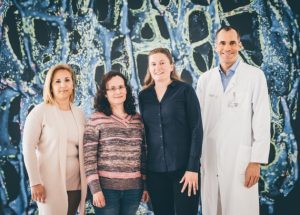
(L-r) Prof Maria Teresa Pisabarro, Dr Gloria Ruiz Gómez, Dr Juliane Salbach-Hirsch and prof Lorenz Hofbauer
An interdisciplinary approach was a key to this challenge.
The Structural Bioinformatics group led by Professor Maria Teresa Pisabarro at the Biotechnology Center (BIOTEC) and the Functional Biomaterials group headed by Dr Vera Hintze at the Max Bergmann Center of Biomaterials (MBC), Institute of Materials Science, both of TU Dresden, combined their know-how with Professor Hofbauer.
“For several years, we have harnessed the power of computer simulations to investigate how proteins regulating bone formation interact with their receptors. All this to design new molecules that can efficiently interfere with these interactions,” Professor Pisabarro said.
“We worked in tandem between the computer and the bench, designing new molecules and testing them, feeding the results back to our molecular models and learning more about the molecular properties required for our goal.”
Finally, the team of Professor Hofbauer’s Bone Lab used a biomaterial loaded with the new molecules on bone defects in mice to test their effectiveness.
The results are reported in the international Biomaterials journal.
The group found that materials containing the novel molecules outperformed the standard biomaterial and enhanced bone healing by up to 50%, which indicates their potential for improving bone regeneration.
The multidisciplinary team used rational drug design to create novel molecules with tailored properties and minimal side effects.
By using computational methods to predict and refine the properties of the designed molecules, the team was able to develop a series of candidates with the greatest potential for turning off the proteins that block bone regeneration.
The expertise of Professor Pisabarro’s group allowed the thorough analysis of the three-dimensional structures of the two proteins that block bone regeneration.
With that, they were able to model their interaction with their receptors in 3D and identify so-called hot spots – specific physicochemical and dynamic properties that are essential for the biological interaction to occur.
Professor Pisabarro said: “We used molecular modelling to design new structures that mimic relevant receptor interactions with both proteins. We wanted this binding to be stronger than their natural interactions.
“In this way, our novel molecules would simultaneously hijack the proteins and effectively turn them off to turn the bone regeneration on.”
Dr Hintze added: “The molecules designed by Professor Pisabarro’s group were synthesized by our colleagues at the Free University of Berlin and then analyzed regarding their protein binding properties via biophysical interaction analysis.
“For each of the molecules we were able to measure the binding strength with the proteins and their interference with natural receptor binding of the proteins.
“Thus, we could reveal empirically how effective each of the small molecules could be at turning off the inhibitory proteins.”
Professor Hofbauer’s group then tested the biological relevance of these interaction studies in a cell culture model, and later in mice.
The results of repetitive testing are a valuable asset that enhances the current molecular models of the Pisabarro group and can be used to guide the development of novel and better molecules in the future.
Such an approach also ensures that animal research is minimized and enters the project only in its final phase.
The newly designed molecules could potentially be used to turn off the proteins that block bone regeneration and lead to the development of novel, more effective treatments for bone fractures and other bone-related conditions.