


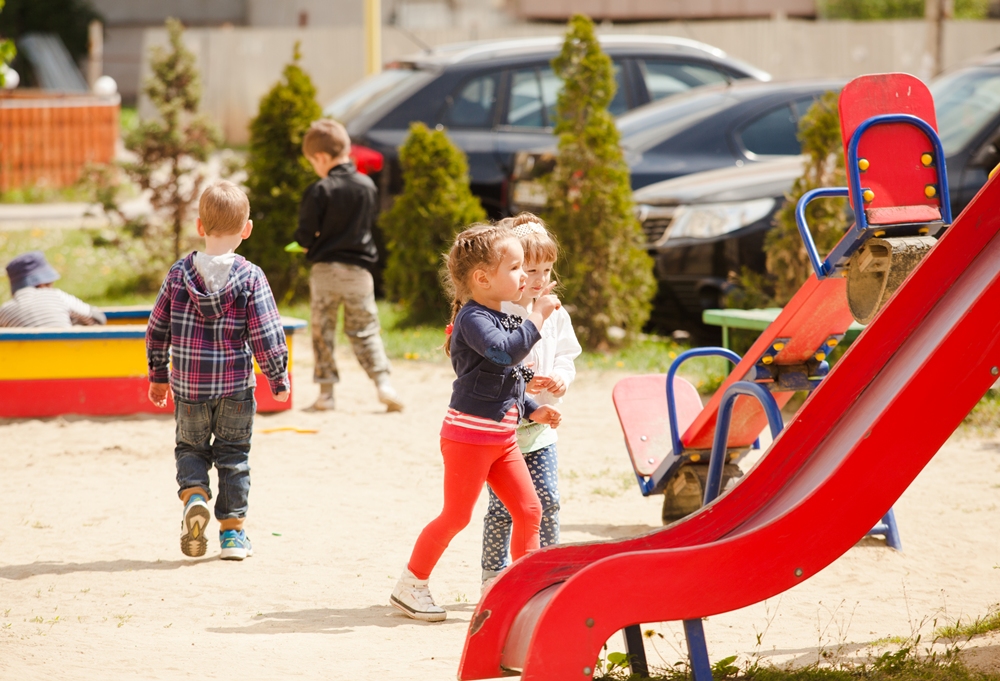
Outdoor play in the preschool years may be linked to better child mental health up to age eight, new research suggests.
The research, led by the University of Exeter and published in the Journal of Child Psychology and Psychiatry, builds on earlier studies linking outdoor play and children’s mental health.
It is the first study to explore how outdoor play in the early years relates to children’s mental health over time.
Most children have low levels of mental health difficulties that stay low across childhood, but some increasingly experience difficulties and others have difficulties from an early age.
These findings suggest the more often children play outdoors as preschoolers, the more likely it is that their mental health problems will stay low through to middle childhood, at age eight.
Professor Helen Dodd from the University of Exeter led the study and said: “Our findings suggest that providing young children with more opportunities to play outside could be a simple, low-cost way to support better mental health and should be considered within public health, education and planning policies.
“This includes providing adequate funding for the provision and maintenance of playgrounds and protection for the range of spaces that children and families use for play, which include informal spaces close to home, parks and other green spaces.
“These public spaces are especially important for people without access to a garden.”
Researchers analysed data from 4,151 children in the Growing Up in Scotland cohort dataset and looked at symptoms of mental health when the children were aged four, five, six and eight.
These included externalising symptoms, which are behaviours such as aggression, impulsivity and hyperactivity, and internalising symptoms, such as anxiety and depression.
The study found that children who played outdoors more often at ages two, three and four were more likely to remain in a low-symptom, good mental health group through to middle childhood.
Specifically, the results showed that for each extra day a child played outdoors in a typical week during the preschool years, the odds of having a healthy profile of mental health symptoms through to age eight increased by between six and 14 per cent.
To isolate the effect of outdoor play, researchers controlled for a range of related factors, including child sex, ethnicity, the highest education level in the household, the number of physical conditions experienced by the child, parents’ working status and whether the family had access to a park within ten minutes of home or a garden.
Marguerite Hunter Blair OBE, chair of the UK Children’s Play Policy Forum, welcomed the study and said: “These findings clearly demonstrate the importance of play-based early interventions that can have a long-lasting positive impact on preschool children’s mental health.
“This evidence shows that our young children will benefit significantly from more play opportunities and better spaces to play. To support this, governments and local authorities must build outdoor play into key policies and work with communities to create and improve these essential play spaces.”
The study, in collaboration with the University of Glasgow, University College London and Complutense University of Madrid, Spain, was supported by funding from UK Research and Innovation and the National Institute for Health and Care Research.