Wellness
New leadless pacemaker could be available to all heart patients this year


Every year more than one million people receive a pacemaker.
Until now, leadless versions were only available for 20% of these patients. However, thanks to an international consortium led by Amsterdam UMC and funded by Abbott Medical, an improved version could later this year be available for all patients.
Research from Amsterdam UMC published in New England Journal of Medicine has succeeded in further revolutionising the wireless pacemaker.
The improved dual-chamber version which is smaller than a AAA battery, can now be placed in both the atrium and the ventricle of the heart via a minimally invasive procedure – meaning a larger group of patients can be fitted with a wireless pacemaker.
A decade ago, Amsterdam UMC laid the foundations for the development of the wireless pacemaker.
At the time it was a huge innovation on the traditional pacemaker, that sits above the skin and reaches the heart muscle with a wire.
However, until now, a wireless pacemaker could only be placed in one cavity of the heart: the ventricle. This meant it was only suitable for a small proportion of patients with a slow heart rhythm.
Now, this latest clinical trial – known as the AVEIR dual-chamber (DR) i2i Investigational Device Exemption (IDE) study – has shown that a device can also be implanted in the atrium of the heart.
The AVEIR-DR has been designed by Abbott with a first-of-its-kind i2i (implant-to-implant) technology with the goal of providing beat-to-beat communication and synchrony between two leadless pacemakers. Unlike other leadless pacemakers, this system allows the two devices to communicate with each other, sensing for delayed or missed heartbeat and then pacing the appropriate chamber of the heart.
In addition, Abbott’s AVEIR leadless devices utilise specially designed attachment mechanisms that allow for retrieval of the pacemakers when changes in therapy are needed.
In the AVEIR DR i2i IDE study, physicians successfully implanted leadless pacemakers in the right atrium along with one inserted in the right ventricle for the first time.
Lead researcher Reinoud Knops, professor of electrophysiology at Amsterdam UMC, said: “Most patients need a pacemaker that works in both the atrium and the ventricle for optimal contraction of the heart. Before now, that wasn’t possible as it is very complicated to place two mini pacemakers that can communicate with each other wirelessly.
“After thorough research and testing, we managed to make it possible. This means that those who need a pacemaker will soon be able to count on a new treatment.”
The new pacemakers communicate with each other via electrical pulses and were implanted for the first time in 300 people who were then followed for a minimum of three months. The results of this study showed that the treatment is safe, and that the system works well.
Pacemakers have been a basic treatment for patients with a slow heart rhythm for many years.
Traditional pacemakers consist of a subcutaneous box under the collarbone with a wire connected to the heart by a vein.
But these cables are fragile and can break, become detached from the heart, or become infected. This can lead to patients having to go back to the hospital for another operation.
For this reason, Amsterdam UMC developed its mini pacemaker without a box or wiring ten years ago, which is the size of a vitamin.
Abbott Medical has announced data from the clinical trial at the same time as Amsterdam UMC and presented its findings at the Heart Rhythm Society’s 44th annual meeting held in New Orleans.
The Chicago-headquartered multinational has also now provided data from the trial to the US Food and Drug Administration (FDA) as part of its submission for approval of the AVEIR device. It is hoped it will get the nod in the US in the third quarter of 2023 and in Europe in 2024.







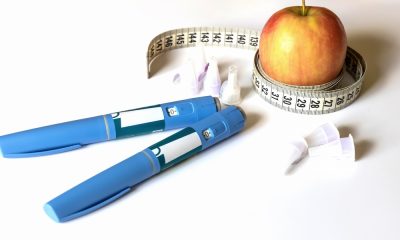
A diabetes and weight loss drug has been shown to cut brain shrinkage in Alzheimer’s by almost 50 per cent.
The drug, liraglutide, is a GLP-1 receptor agonist, a class that copies a gut hormone which helps regulate blood sugar and appetite.
The family includes semaglutide, known as Wegovy or Ozempic.
In a study involving 204 patients with mild Alzheimer’s disease, led by professor Paul Edison, those given liraglutide had less brain shrinkage and slower cognitive decline than those on placebo.
Reduced shrinkage was seen in the frontal, temporal and parietal lobes, as well as total grey matter. These brain areas support memory, learning, language and decision-making.
The research suggests liraglutide may protect the brains of people with mild Alzheimer’s disease and cut cognitive decline by as much as 18 per cent after one year of treatment.
Researchers believe the drug’s protective effect may stem from actions on inflammation, the build-up of harmful proteins, insulin resistance and amyloid accumulation.
Professor Paul Edison, professor of neuroscience at Imperial’s Department of Brain Sciences, said: “We think liraglutide is protecting the brain possibly by reducing inflammation, lowering insulin resistance and the toxic effects of Alzheimer’s biomarkers or improving how the brain’s nerve cells communicate.”
The randomised, double-blind, placebo-controlled trial included patients seen at 24 clinics across the UK.
Half received a daily injection of up to 1.8 mg of liraglutide, while the other half received a placebo injection.
Because liraglutide and other GLP-1 drugs are already licensed for managing obesity and diabetes, their path to treatment for Alzheimer’s could be relatively swift.
Professor Edison added: “If scientists are able to further demonstrate that this is working in patients with Alzheimer’s disease phase 3 trials, and the FDA approves it for Alzheimer’s, this drug could then be immediately available.
Two independent phase 3 trials are already under way, with findings due at the end of 2025.


A treatment using particles from stem cells can slow and even reverse aspects of age-related memory decline, new research suggests.
The study found that tiny vesicles, small sacs released by bone marrow stem cells, helped maintain memory and improved communication between brain areas over two years in an experimental model.
Researchers at Boston University worked with middle-aged subjects.
Half received regular infusions of extracellular vesicles from young, healthy donor cells every two weeks for a year and a half, while the other half received a control without vesicles.
The vesicles contain molecules including proteins, lipids and RNAs that help reduce inflammation and support brain cells in responding to age-related stress.
Subjects completed memory and learning tests before and after treatment, and MRI scans assessed how efficiently different brain regions were connected.
At the end of the study, those who received the vesicles showed better working memory and signs of healthier brain connections.
“By applying secreted stem cells, specifically EVs, we found that the ageing brain retains a remarkable capacity for resilience,” said corresponding author Evan Mackie, a PhD student in the university’s department of anatomy and neurobiology.
“Our findings suggest that ageing is not set in stone; that brain health can be supported and maintained even in older age.”
The researchers describe this as the first study of its kind to show the treatment can protect the brain’s structure and function during normal ageing in a model closely related to humans.
Senior author Tara L Moore, professor of anatomy and neurobiology, added: “Because similar vulnerabilities in brain structure and function also occur in conditions such as Alzheimer’s disease, multiple sclerosis, stroke and brain injury, this approach may one day help protect the brain in both healthy ageing and disease.”

Agetech World’s innovation & investment round-up

Gut bacteria offers new hope for diabetes

Weight loss drug slows Alzheimer’s decline, study finds

GPs failing older people living with frailty, report finds

Treatment can slow or reverse age-related memory decline – study

US$100m UK tech entrepreneurs shift focus from real estate to longevity

Scientists closer to halting ageing at its biological roots

Weight loss jabs my only temporarily reduce ‘food noise,’ study finds

Supplement could restore memories lost by Alzheimer’s, study finds

Eating cheese linked to lower dementia risk
 News4 weeks ago
US$100m UK tech entrepreneurs shift focus from real estate to longevity
- Wellness4 weeks ago
Scientists closer to halting ageing at its biological roots
- News3 weeks ago
Weight loss jabs my only temporarily reduce ‘food noise,’ study finds
- News4 weeks ago
Supplement could restore memories lost by Alzheimer’s, study finds
- News2 weeks ago
Eating cheese linked to lower dementia risk
- News4 weeks ago
Gladys raises £1.5m for AI home care
- Independence4 weeks ago
Forus gains AI backing with 21 per cent stake
- News2 weeks ago
Interview: How speech and language software could transform dementia diagnosis