


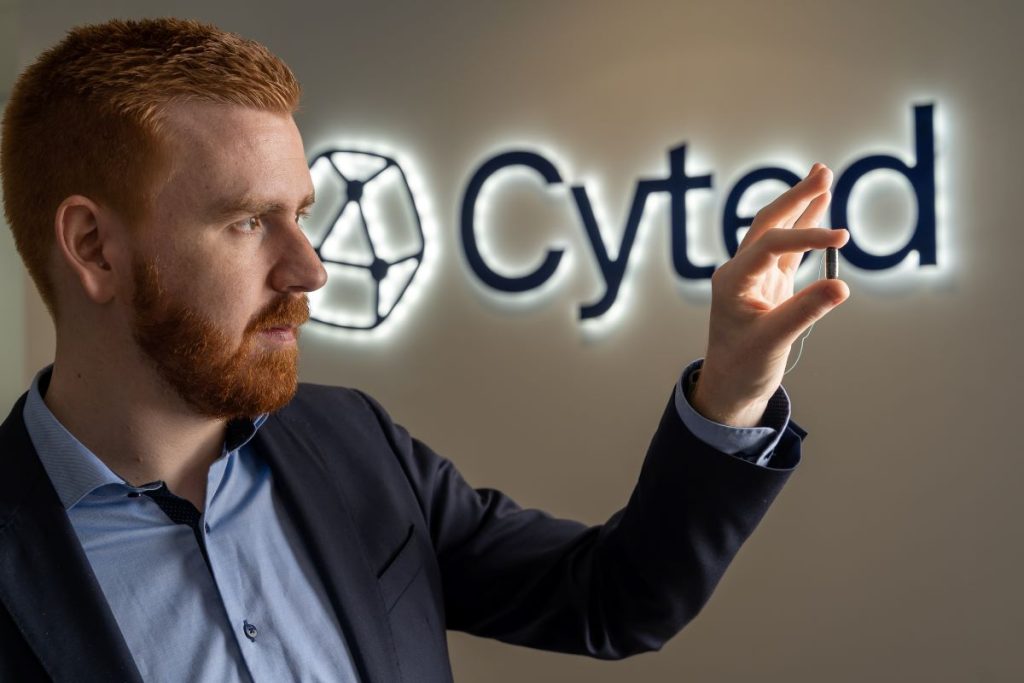
An innovative test to help detect the early stages of oesophageal cancer, has won £3.4m in grant funding.
It means more diagnostic tests can be offered to NHS patients in primary and community care settings, diverting them away from lengthy hospital endoscopy waiting lists.
One of the biggest grants of its kind, the multi-million pound funding boost will allow UK-based Cyted to run additional clinics to identify patients suffering from Barrett’s oesophagus, a potentially serious complication of gastroesophageal reflux disease (GERD), which can develop into cancer of the lower gullet.
Chronic reflux patients benefiting from the programme will be able to take a quick and easy test in under 10 minutes in community settings, like a GP surgery, to diagnose Barrett’s oesophagus symptoms.
The non-invasive Cytosponge test is shaped like a small pill with a thread attached. Swallowed by patients, once in the stomach the capsule dissolves, releasing a small spongy ball about the size of a 50p coin. A health professional pulls the string to bring the soft ball back up the throat, where it collects cells from the oesophagus lining.
Clinicians at Cyted’s laboratory then analyse patient samples, with the help of AI technology.
Patients with signs of early cancer can then be prioritised for endoscopes, making it easier to triage waiting lists and reduce the pressure on such services.
There has, to date, been no easy way to identify Barrett’s oesophagus patients, The condition typically affects middle-aged and older adults with its prevalence estimated to be as high as 400 per 100,000 individuals globally. It is more common in men than women.
According to Cyted, nine in 10 sufferers are unaware they have Barrett’s oesophagus. Oesophageal cancer is not normally diagnosed until a late stage.
The significant injection of funds comes from the NHS Cancer Programme, supported by NHS England’s Small Business Research Initiative for Healthcare (SBRI) and Accelerated Access Collaborative, and is aimed at enabling the enhancement of efficiency, coordination and communication throughout the care pathway for people living with chronic reflux.
This latest round of money follows a £500,000 SBRI grant awarded last year to Cyted to pilot its test technology in community care settings in the North West of England.
Both grants were awarded as part of Cambridge-headquartered Cyted’s work to bring more testing into the community to increase accessibility for people living with chronic reflux and Barrett’s oesophagus.

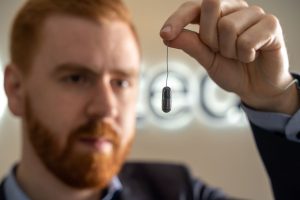
Cyted CEO Marcel Gehrung with the Cytosponge
Cyted’s diagnostic platform was pioneered by Rebecca Fitzgerald, professor of Cancer Prevention at the University of Cambridge. It began as a germ of an idea more than 20 years ago when she was working in London and overheard a colleague say a bottle brush was needed to gather medical information from the oesophagus, which is a long, narrow muscular tube between 25cm-33cm long and about 2cm across at its smallest part.
She put her mind to thinking of a way cells could be collected from the tube, through which food passes from the throat to the stomach. Early on she realised it would have to be combined with a laboratory test to find abnormal pre-cancerous cells. So it was that the notion for the Cytosponge test was born.
It brings together a non-invasive test with data-driven biomarkers for early detection and risk stratification of cancers and inflammatory diseases.
Its first application is in oesophageal cancer – the sixth leading cause of cancer-related death worldwide.
But the developers say the technology can be applied to other diseases, including prostate, skin and bowel cancers. By identifying the signs of disease and allowing clinicians to stop it in its tracks, Cyted believes tens of thousands of lives could be saved every year,
The company has already delivered over 15,000 tests in more than 80 hospitals to diagnose and monitor patients who are suffering from Barrett’s oesophagus.
Across the world, late diagnoses and long waiting times for endoscopies can lead to poor survival rates. Cyted’s technology helps to identify cancer in its earliest stages when treatment can be more effective.
Cyted CEO Marcel Gehrung, a scientist and serial entrepreneur, said the funding is “great news for Cyted and for patients. It means we can get more quick, efficient tests out into communities, and make sure people can receive swift diagnoses without having to come into hospital. We are building on a long partnership with the NHS and looking forward to expanding that work.
“This substantial grant underlines the global potential of Cyted’s diagnostic technology. Worldwide, oesophageal cancer is a major global health issue and our non-invasive test can make a significant contribution to shortening waiting times and saving lives.”