Dementia is not the end of learning says new study

Loss of memory and the ability to think doesn’t mean dementia patients no longer have the capacity to learn new things, a new study has revealed.
The study presented at Linköping University in Sweden has debunked the widely held belief that people with dementia are just empty shells.
Study author Elias Ingebrand, of the university’s Department of Culture and Society, Division of Ageing and Social Change, let 10 dementia sufferers, eight of whom lived in care facilities, try using computer tablets for the first time in their lives.
A staff member or a loved one was there for support, but the only instruction given to participants was to use the tablet as they wished.
Rather than ignoring the device as Mr Ingebrand had presumed, the participants instead showed curiosity and wanted to find out more.
He said: “I was rather surprised at this. I may have expected that it would just lie there and that they would talk about something else, but we saw that they focused their attention on it.”
Although the participants suffered from severe memory decline, over the course of the study, which lasted for between four and six weeks, they gradually learned to use the tablet more independently.
The explanation, Mr Ingebrand believes, is that the body remembers the movements required even though the ability to talk about it has been lost. But it is important to arouse the person’s interest.
One case cited is of a woman who used to do orienteering, who spontaneously started using the tablet to check competition results.
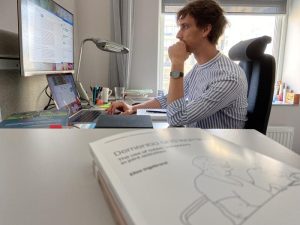
According to Elias Ingebrand, people with dementia can still learn new things.
In another example, a man who used to be restless and aggressive learned how to navigate to the Open Archive of SVT, the Swedish public television broadcaster. After a time, staff noted he would sit and focus his attention on calmly watching the screen. This was a side of him they had never seen before.
Mr Ingebrand admitted he was surprised to find that people with dementia could solve the mysteries of the tablet without help from staff or loved ones, by collaborating and learning from each other, and that they were able to focus on the task in hand.
Previous studies have found that people with dementia have the ability to learn new things. This has involved remembering nonsense words or the names of random people.
But Mr Ingebrand believes his work is the first to have studied collaboration between sufferers and to have shown that learning can take place even without any particular instructions. The results, he said, could be immediately applied in dementia care.
“My thesis has an impact on how we look at people with dementia. They are not to be treated as children, but as people who still have a will and an incentive to do things.
“This is ultimately about having the opportunity to participate in meaningful activities based on the person’s own interests and desires,” he explained.
Mr Ingebrand conceded this may present a challenge to care facility staff, who are often too busy to sit down with just one person for any length of time.
Letting people with dementia do things in collaboration could be a solution, however.
While the study used computer tablets, Mr Ingebrand maintained the results are valid for other forms of learning.
He said: “I want to take my research further by finding out how to make use of the knowledge and expertise of people with dementia in creating meaningful activities.
“Maybe someone could initiate an activity and teach others in the care facility. Perhaps a small seminar, or knitting. The right to lifelong learning should include everyone; the important thing is getting a chance to learn.”