Taurine – a nutrient produced in the body and found in many foods – could be an “elixir of life” that boosts health and helps us live longer, a leading scientist says.
A deficiency of taurine is a driver of ageing in animals. But experiments on middle-aged animals conducted as part of a study led by Columbia University researchers in the United States and published in the journal Science, have shown that boosting taurine levels can slow down the ageing process.
In one case, it was found to extend the healthy lifespan of middle-aged mice by up to 12%.
Whilst topping up taurine levels in humans has not yet been tested, the study’s lead, Vijay Yadav, assistant professor of genetics and development at Columbia University’s Vagelos College of Physicians and Surgeons, said: “For the last 25 years, scientists have been trying to find factors that not only let us live longer, but also increase healthspan, the time we remain healthy in our old age.
“This study suggests that taurine could be an elixir of life within us that helps us live longer and healthier lives.”
Human life expectancy has doubled in the last 200 years. Since the start of the 21st Century, life expectancy has risen by more than six years globally from 66.8 years to 73.4, according to the World Health Organisation.
CREDIT: Columbia University Irving Medical Center
Over the last two decades, efforts to identify interventions that improve health in old age have intensified and scientists have learned that the ageing process can be manipulated.
Many studies have found that various molecules carried through the bloodstream are associated with ageing. Less certain is whether these molecules actively direct the ageing process or are just passengers going along for the ride.
If a molecule is a driver of ageing, then restoring its youthful levels would delay the process of growing old and increase the years we spend in good health.
Taurine – which is a free amino acid found naturally in foods with protein such as meat, dairy and fish, can be bought as a supplement, and is widely used in energy drinks – first came into Dr Yadav’s view during his previous research into osteoporosis that uncovered the nutrient’s role in building bone.
Around the same time, other researchers were finding that taurine levels correlated with immune and nervous system functions, and obesity.
Dr Yadav said: “We realised that if taurine is regulating all these processes that decline with age, maybe taurine levels in the bloodstream affect overall health and lifespan.”
First, Dr Yadav’s team looked at levels of taurine in the bloodstream of mice, monkeys, and people and found its abundance decreases substantially with age. In people, taurine levels in 60-year-old individuals were only about one-third of those found in five-year-olds.
“That’s when we started to ask if taurine deficiency is a driver of the ageing process, and we set up a large experiment with mice,” Dr Yadav explained.
The researchers started with close to 250 14-month-old female and male mice (about 45 years old in human terms).
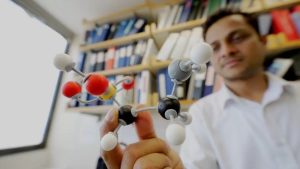
Dr Vijay Yadav holding a model of the chemical structure of taurine. Image Columbia University Irving Medical Center
Every day, the researcher fed half of them a bolus of taurine or a control solution. At the end of the experiment, Dr Yadav and his team found that taurine increased average lifespan by 12% in female mice and 10% in males.
For the mice, that meant three to four extra months, equivalent to about seven or eight human years.
To learn how the nutrient impacted health, Dr Yadav brought in other researchers who investigated the effect of taurine supplementation on the health and lifespan in several species.
They measured various health parameters in mice and found that at age two (60 in human years), animals supplemented with taurine for one year were healthier in almost every way than their untreated counterparts.
Among the benefits identified, taurine suppressed age-associated weight gain in female mice (even in ‘menopausal’ rodents ), increased energy expenditure and bone mass, improved muscle endurance and strength, reduced depression-like and anxious behaviours, as well as insulin resistance, and promoted a younger-looking immune system.
Dr Yadav said: “Not only did we find that the animals lived longer, we also found that they’re living healthier lives.”
At a cellular level, taurine also improved many functions that usually decline with age, such as DNA damage and the ability of tissue to heal following an injury.
Similar positive health effects were seen in middle-aged rhesus monkeys, which were given daily taurine supplements for six months.
Taurine prevented weight gain, reduced fasting blood glucose and markers of liver damage, increased bone density in the spine and legs, and improved the health of their immune systems.
The researchers do not know yet if taurine supplements will improve health or increase longevity in humans, but two experiments they conducted suggest it has potential.
In the first, Dr Yadav and his team looked at the relationship between taurine levels and approximately 50 health parameters in 12,000 European adults aged 60-plus.
Overall, people with higher taurine levels were healthier, with fewer cases of type 2 diabetes, lower rates of obesity, and reduced hypertension and inflammation.
“These are associations, which do not establish causation,” Dr Yadav admitted, “but the results are consistent with the possibility that taurine deficiency contributes to human ageing.”
The second study tested if taurine levels would respond to an intervention known to improve health: exercise.
The researchers measured taurine levels before and after a variety of male athletes and sedentary individuals finished a strenuous cycling workout. They found a significant increase in taurine among all groups of athletes (sprinters, endurance runners, and natural bodybuilders) and sedentary individuals.
Dr Yadav said: “No matter the individual, all had increased taurine levels after exercise, which suggests that some of the health benefits of exercise may come from an increase in taurine.”
Only a randomised clinical trial in people will determine if taurine truly has health benefits, Dr Yadav added.
Taurine trials are currently underway for obesity, but none are designed to measure a wide range of health parameters.
Other potential anti-ageing drugs – including metformin, rapamycin, and NAD analogs – are being considered for testing in clinical trials.
“I think taurine should also be considered,” Dr Yadav said. “And it has some advantages. Taurine is naturally produced in our bodies, it can be obtained naturally in the diet, it has no known toxic effects, although it’s rarely used in concentrations, and it can be boosted by exercise.
“Taurine abundance goes down with age, so restoring taurine to a youthful level in old age may be a promising anti-ageing strategy.”