



“Imagine it’s construction season in Michigan. Normally, it might take you 10 to 15 minutes to get from point A to point B.
“But when there is construction, it slows you down, now taking 15 to 20 minutes. And if the highway is closed, it might take you even longer.”
Irving Vega is describing what happens when cells in the central nervous system stop working or die.
More commonly known as neurodegeneration, its devastating consequences affect countless millions of people worldwide.
Alzheimer’s and Parkinson’s are perhaps the two best-known neurodegenerative diseases. But the disorder is also responsible for Huntington’s disease, Amyotrophic lateral sclerosis (ALS), and motor neuron disease, amongst others.
Expanding on his building analogy and how such work can slow down the flow of traffic, Dr Vega says: “That’s what happens in a brain that is undergoing neurodegeneration. The streets start to close, and it takes longer and longer to reach that memory to a point that you don’t have any alternative route to get from point A to point B, and that memory is completely gone.
“For some individuals, they can live all their life with those pathological hallmarks in their brain and never have clinical presentation. For others, they have the clinical presentation at 70.
“But it’s not because they developed it when they were 70. They probably were developing that since they were in their 40s.”
The likelihood of developing a neurodegenerative disease rises dramatically with age. And as life expectancy increases, more people than ever are predicted to be affected by such diseases in the coming decades.
Improving our understanding of what causes neurodegenerative diseases and developing new approaches to understanding, treating and hopefully one day preventing them, has been Dr Vega’s life work.

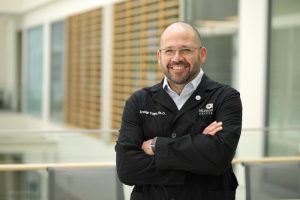
Dr Irving Vega. Image: MSU College of Human Medicine
A neuroscientist at Michigan State University (MSU) in the US, he spends much of his time in his laboratory studying the impact of certain proteins on the development of neurodegenerative disorders, most notably Alzheimer’s.
But when he’s not conducting research, Dr Vega makes time to engage with students about their interest in science. and to go out into the community to talk about Alzheimer’s, a cruel and insidious disease which currently affects around 55 million worldwide and mercilessly robs patients of their memories, social skills, independence, and eventually their life.
He says: “I’ll go to the Hispanic Centre. I’ll go to the school system in Grand Rapids. I’ll go anywhere they invite me.”
The associate professor in the Department of Translational Neuroscience at MSU, adds: “I believe it’s important to build that bridge of communication between researchers and members of the community so that we can provide access to the new knowledge that we develop.”
While that outreach often happens in West Michigan, Dr Vega also collaborates with institutions elsewhere.
“I want to bring attention to the importance of building a bridge of communication between researchers and the community so that, in a way, we are actually better informed on what the important questions are that are relevant for the community so that we can go back to the bench and then do our research,” he explains.
Dr Vega obtained his undergraduate degree from the University of Puerto Rica at Mayagüez on the Caribbean island where he was born and raised. He was a National Institutes of Health Maximising Access to Research Careers, or MARC, fellow.
He then earned a doctorate from Rutgers University in New Jersey, and completed his postdoctoral fellowship in the Department of Neuroscience at the Mayo Clinic in Jacksonville, Florida, where he developed his research career focusing on the pathobiology of Alzheimer’s disease.
Dr Vega developed his interest in working with the community during his time at the University of Puerto Rico’s Rio Piedras campus, where he rose through the academic ranks from assistant professor to assistant dean of research.
In addition to his analysis work, Dr Vega grew an undergraduate training programme to enhance diversity in neuroscience and after joining MSU in 2014, he continued with both his research and his interest in mentoring students and reaching out to the community.
In 2022, Dr Vega was recognised as a Red Cedar Distinguished Faculty for his community-engaged research.
Located on MSU’s Grand Rapids campus, Dr Vega’s laboratory focuses on three main areas.
First, the researchers study the mechanisms that cause tau proteins – which help stabilise the internal structure of neurons in the brain – to clump together, leading to toxicity within the cells that house them.
It was this team that in 2019 identified the tau protein EFhd2 – a novel amyloid protein associated with pathological tau in Alzheimer’s disease. They are currently evaluating the role this protein plays with Alzheimer’s disease to establish models that could be used to test potential therapeutics against tau aggregation.
The second focus of Dr Vega’s lab is investigating the potential links between intestinal bacteria changes, inflammation, and Alzheimer’s disease.
A third area of focus is the development of better diagnostic tools for Alzheimer’s disease. Dr Vega and his colleagues are currently looking at non-invasive methods to detect biomarkers (such as the tau protein); checking whether race and ethnicity affect those levels; as well as looking to identify new biological molecules that could eventually lead to better diagnostic tools.
Dr Vega and his team never lose sight of the fact that Alzheimer’s disease is more than just a strand of research and that in America alone it affects 6.7 million people. He says that in Michigan alone it’s forecast 220,000 people will be living with the disease by 2050.
He says the illness disproportionately affects communities of colour.
“We know that people in the Latino community are at a higher risk of developing these illnesses, but we don’t know exactly why.”

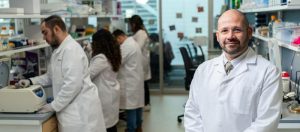
Dr Irving Vega in his lab at MSU’s Department of Translational Neuroscience. Image: MSU College of Human Medicine
He adds that while there’s consensus on the risk factors – metabolic disorders, diabetes, high cholesterol, hypertension – contextual or social factors related to ethnic and racial health disparities are less clear.
About 13% of Hispanics older than 65 have Alzheimer’s or another type of dementia. And Hispanics are 50% more likely than their peers to develop Alzheimer’s or other types of dementia.
“There are a lot of barriers to access health care. There are barriers to accessing healthy food. There are barriers to quality education. There is discrimination, and there is higher social stress due to discrimination,” he says. “The high levels of stress lead to biological changes in the individual.”
He admits that coming up with solutions is not easy.
“We know what is very good for your brain: exercise, good quality of sleep, a healthy diet. For underserved populations there are things that prevent people from doing exercise. There’s no safety on the roads or at the park. Sometimes they have two jobs and no time to exercise. Maybe they are not eating well or sleeping well. There’s a lot of things that we can do to reduce the risk, but we have a huge fight against us to achieve health equity.”
Dr Vega recently presented his research in front of 35 community members at the request of the Catholic Diocese of Grand Rapids.
He talked about how the brain works, the different regions of the organ that are responsible for different tasks, and how they coordinate with each other to produce an outcome.
Then, he discussed neurodegenerative diseases, their risk factors and how to mitigate them. Hence his drawing on the construction analogy; a relatable comparison highlighting the raw horror of cognitive decline, as patients’ families and friends are forced to watch the comprehensive disintegration of their loved one’s brain.
Dr Vega says: “Once I get to that part of my presentation, people start asking ‘How I can reduce my risk?’
“This is the third part of my talk — explaining how you can reduce your risk of developing these diseases. If you sleep well, this is what happens to your brain. If you eat well, this is what happens to your brain. If you exercise, this is what happens to your brain.”
He says community members enjoy having researchers explain their work to them. He believes researchers stay inside their lab to their own detriment.
“Sometimes by not being connected with the community and people living with the diseases that we’re trying to understand, we miss a lot of points and references on how these diseases affect people in different ways and the risk factors that contribute to them.”