


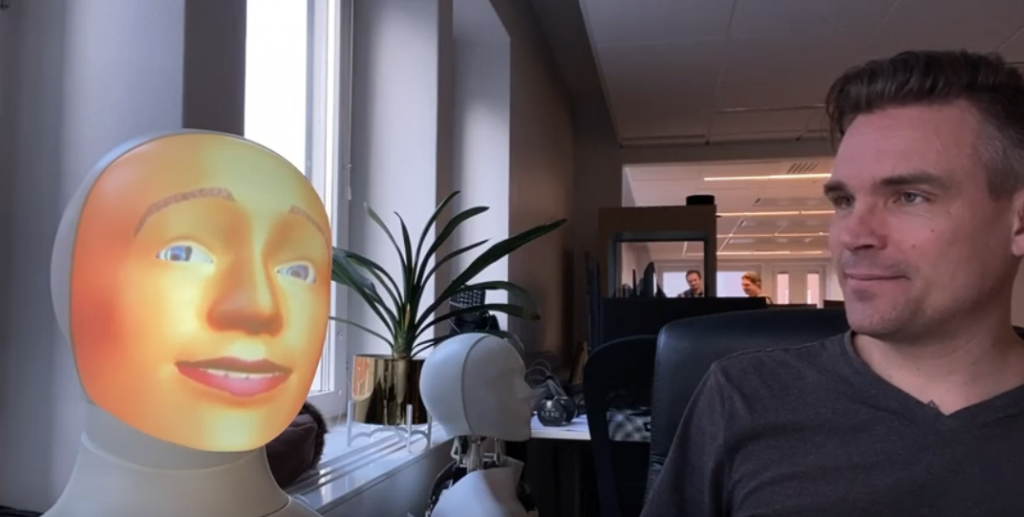
Researchers in Scotland are to investigate whether an AI-powered desktop robot could improve the lives of people with dementia.
The National Robotarium, hosted by Heriot-Watt and Edinburgh Universities, will see whether the robot, called Furhat, can help to reduce memory loss and improve communication.
The four-year project will also study the effect of a graphic character on a tablet, which will be easier and cheaper for patients to access in the short term.
In both cases, the AI-powered ‘companion’ will attempt to elicit memories using photos, video and sound from the patient’s life, as well as cultural events from their lifetime.
The research is lead by Professor Ruth Aylett of the National Robotarium and supported by dementia experts as Strathclyde University.
Studies suggest that a physical object can have more of an impact than a character on a screen, Prof. Aylett said.
The researcher hopes that the patients will find the companion to be ‘believable’, comparing the concept to a cartoon character.
The researcher said:
“People know they’re not real, and they don’t expect them to have the full capacity of humans either.
“But they are interesting to interact with and people quite enjoy them.
“They don’t see them as being a person as such, but they’re willing to suspend their disbelief to some extent and treat them a little bit as if they were real, even though they know they’re not real.”
AI has the potential to improve the lives of patients with cognitive diseases, Prof. Aylett said.
She added:
“One of the most difficult aspects of living with dementia can be changes in behaviour caused by confusion or distress.
“We know that people can experience very different symptoms that require a range of support responses.
“Current intervention platforms used to aid memory recollection often take a one-size-fits-all approach that isn’t always suitable to an individual’s unique needs.”
Dr Mei Yii Lim, who came up with the ‘Agent-based Memory Prosthesis to Encourage Reminiscing’ (AMPER) project, said:
“AMPER will explore the potential for AI to help access an individual’s personal memories residing in the still viable regions of the brain by creating natural, relatable stories.
“These will be tailored to their unique life experiences, age, social context and changing needs to encourage reminiscing.”
Image: Furhat Robotics/YouTube