


AgeTech World meets Joe Miller, Pocketalk general manager, to explore how healthcare providers can overcome language barriers.
Hospitals and other healthcare providers are facing a growing challenge to meet the changing communication needs of the UK’s increasingly diverse population. Around one in 10 people in the UK don’t speak English as their first language. This figure rises to around one in five people in areas like London.
These numbers are set to grow as data from the ONS shows that over the next 25 years net international migration will account for almost three quarters of UK population growth, which may mean that overcoming language barriers will be a huge issue in the future of healthcare.


Tech company Pocketalk conducted a research with 1,000 healthcare workers from across the UK in October 2021 which found that a fifth of those surveyed said they have faced language barriers when communicating with colleagues and patients, as often as every day.
Joe Miller, general manager at Pocketalk, explains that translating devices can benefit both the caregiver and the patient.
“Not every translation requires an appointment with a translator,” says Miller. “The patient may ask something as simple as ‘can you help me adjust the pillow?’ or ‘can I have a glass of water?.”
NHS provides The Interpretation and Translation Services which supplies a variety of translation and interpretation services. These services include face to face, British sign language, telephone interpretation and translation, document translation and video translation and interpretation.
During a typical working week, as much as four and a half hours are spent by nurses, doctors and other healthcare professionals managing communication breakdowns, originated from language barriers. So, what can be done?
This is when technology comes in to help. Pocketalk is a multi-sensory two-way translation device that provides an experience across 82 languages, including localised dialects and slang. The device is GDPR and HIPAA compliant and it has a bulletin camera on the back which allows users to translate text.
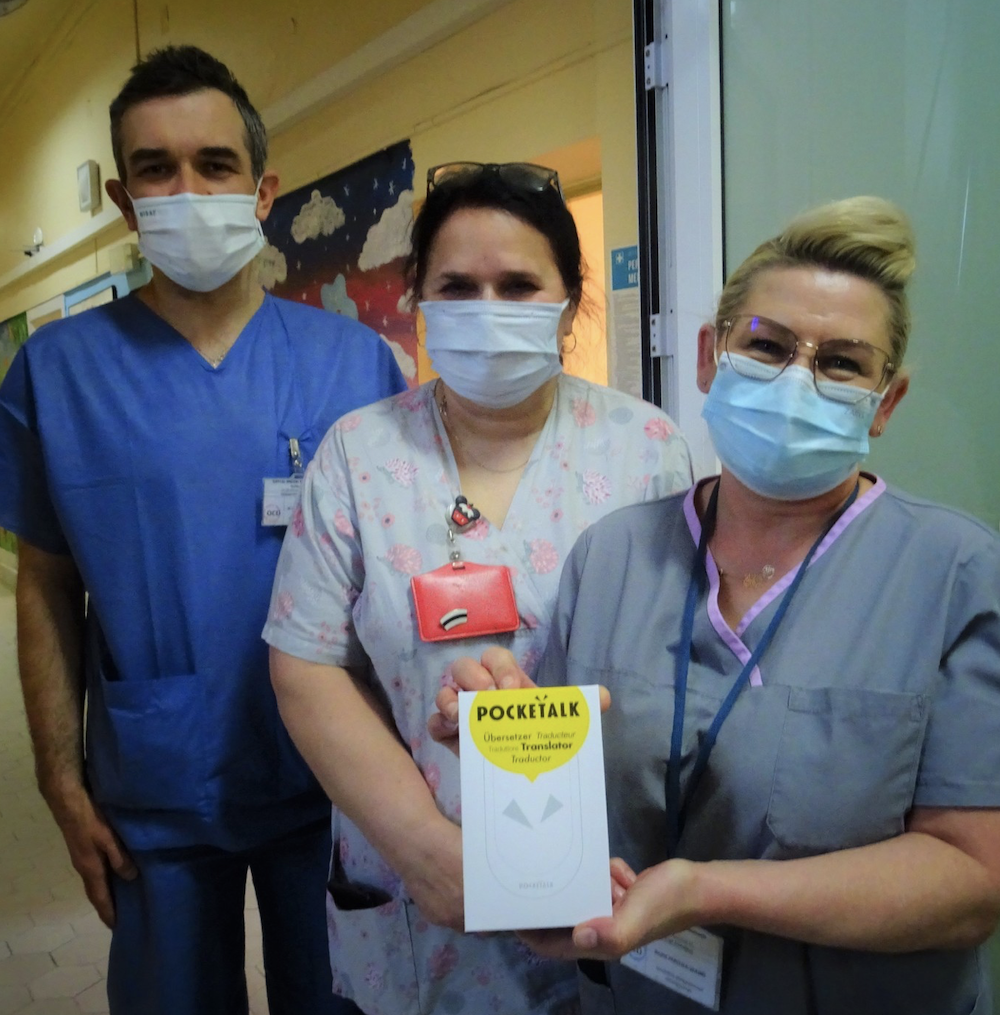

Miller says: “Pocketalk can primarily benefit caregivers and patients. When you’re seeking medical care, not every kind of translation requires an appointment with a translator.
“When a patient is in a medical facility, the ability for both parties [patient and caregiver] to get to know each other is very helpful.”
As language barriers can prevent patients from engaging in seamless conversations with their doctors, this can result in miscommunication which could potentially be life-threatening.
Miller explains that, numerous times, patients do not speak up because “they don’t want to be a burden” or because they feel embarrassed.
Translation devices can break language barriers as users become “not afraid to ask or talk, communicate or share”.


A first responder who uses Pocketalk says: “While working on the ambulance we were dispatched to a job that the call taker wasn’t able to distinguish the call type. It cam eover as an “unknown”. When we arrived, we found an elderly Hispanic, Spanish speaking woman who was showing signs of Covid such as persistent cough and high temperature.
“Things didn’t seem to add up entirely, she was frantic and disorganised.While using the Pocketalk my partner and I were able to assess and determine that the patient was showing signs of serious brain bleed. We were able to expeditiously transport her to the appropriate specialised hospital for her time sensitive medical emergency.”
With 573,000 people who migrated into the UK in the year ending June 2021, an effort from healthcare systems is needed to overcome the consequential language barriers.
“We’re just at the beginning of this journey,” says Miller. “The future of technology will get richer, with richer vocabularies that perhaps will be able to reflect the patient own voice.
“This will make dialogue more natural, more comfortable and much more like a natural speech between two people.”