


Interview: Dr Matthew Bennett on building resilience and a pain-free healthspan
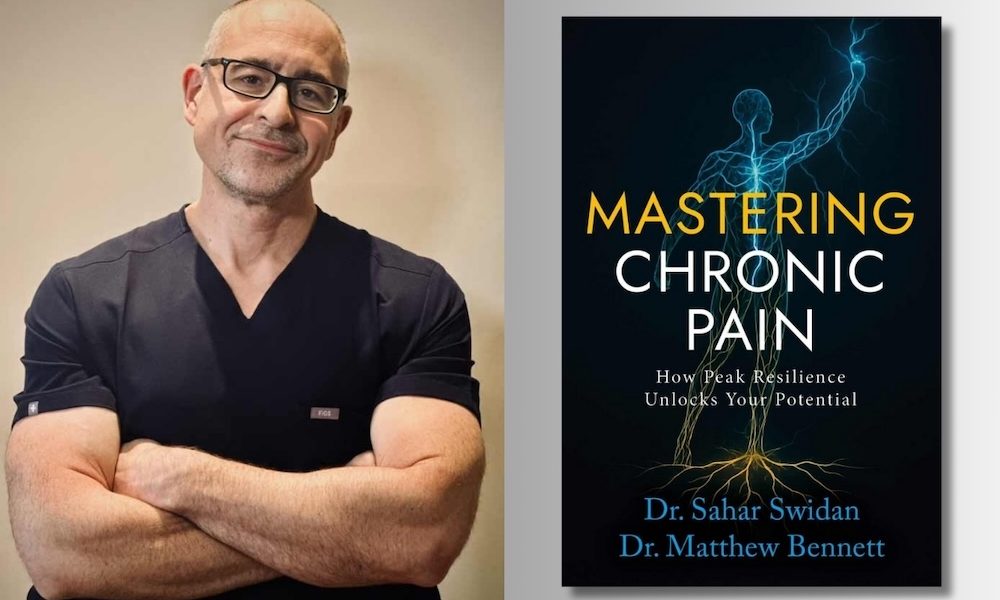
Harnessing the multi-dimensional capabilities of the human body is key to overcoming chronic pain and boosting longevity, say the authors of a new book.
While the primary focus of established health care systems is to target pain points through medication or surgery a more holistic approach is emerging, as US chronic pain doctor Matthew Bennett explains.
Published late last year by Dr Bennett and colleague Dr Sahar Swidan’s book, Mastering Chronic Pain: How Peak Resilience Unlocks Your Potential offers grounded insights into pain resolution.
Speaking to Agetech World from his New York base he said: “I’ve been treating patients in chronic pain for over 20 years.
“And, it becomes obvious that while some pain is very responsive to simple interventions, like a nerve block or a surgery, there’s a large number of people which that does not move the needle for.
“We used to look at it like, ‘Hey, the MRI shows this one spot that’s pushing on this one nerve. If we can take that spot off that nerve, everything’s going to be better’.
“And, that just doesn’t always play out that way. It’s become apparent that there are a lot of situations where the problem is more systemic.
“It’s really more of a metabolic problem, and pain is the expression of these system failures.”
‘Fight or flight’
The upstream drivers of acute pain can be numerous as Dr Bennett explains: “You can take as much pressure as you want off of nerves, but if your inflammatory system isn’t fixed, if the neurological system isn’t fixed, if your autonomic nervous system – meaning your fight-or-flight versus your rest-and-relaxation – isn’t balanced, if your gut biome is off, if your sleep is off – a lot of these problems aren’t going to improve.”
Key elements in developing a longevity-focused healthpsan – devoid of chronic pain and opioids – are simple, every day measures, focused on movement, sleep and breathing.
This includes developing the right muscles to create a ‘good deep core musculature’.
He continued: “An even bigger one is the way people breathe – the way they use their diaphragm.
“The diaphragm is a great big muscle that controls the deep core part of the spine. When the diaphragm’s not working correctly, the whole core musculature isn’t working right.
“You can’t get that stability in the lower spine, so other muscles jump in and try to do the work for you. That causes downstream problems.
“You need someone getting to that root cause,.. (and) we teach people how to do that, and they’ll have big breakthroughs.”
He continued: “Sleep is a big problem in people with chronic pain. There’s a lot of healing that occurs with deep sleep.
“Unfortunately, in a lot of pain states, sleep gets disrupted, and people can’t get into deep sleep, so the brain can’t clear itself of the byproducts of metabolism; that glymphatic system doesn’t work.
“Poor sleep also interferes with endocrine connectors; growth or sex hormones can be depleted. Obstructive sleep apnea can play a huge role. There’s just a big correlation between sleep disorders and chronic pain.”
Seeking calm
These key elements of Dr Bennett’s work – which has been described as ‘biopsychosocial’ – come concomitant with a keen focus on nervous systems, chronic inflammation and neuroplasticity.
Dr Bennett, co-founder of NoceViva, continued: “When we think about neurologics, one of the things that’s very far upstream of a lot of health is the balance between the fight-or-flight system and the rest-and-relaxation system – that autonomic nervous system.
“All of these things are ‘two-way streets’ with pain; meaning the pain can cause the dysfunction, and the dysfunction can cause the pain; it becomes this feedback cycle where things get entrenched in a bad loop.
“So, balancing that autonomic nervous system is a really helpful upstream fix to make. Simple things like breathwork. Some people do well with meditation.
“Some people do well with making sure they’re involved in hobbies. These are things that can help just calm that fight-or-flight system down.”
Nerves & neuroplasticity
Allowing ourselves to adjust to emerging health challenges is achievable in the right settings and with the right approach.
He continued: “The body’s nervous system has the ability to change. And it can change based on various inputs.
“The nervous system can become increasingly sensitised, or it can become de-sensitised. And so that’s one of the bigger things that we see in the chronic pain state, is this sensitisation that comes along with it.
“This neuroplasticity can make the nerves in the extremities more sensitive.
“It can also make the nerves in the central nervous system more sensitive – so nerves in the spinal cord, or even nerves in the brain can become hyper-sensitised – so they’re triggering more of a pain response in the person.
“But the same thing that can cause the system to go in what we would consider a bad direction, where it gets more sensitive, the neuroplasticity can actually become undone, and you can make the nerves less sensitive.”
AI to boost lifespan?
Looking ahead Dr Bennett foresees a future where a deeper understanding of the functional pathways of pain, combined with AI, stem cell therapies and regenerative biologics will all speak to a future of greater longevity for mankind.
“I think the more attentive we are to the root cause, the more attentive we are to functional pathways – when we start thinking about how the system really works? And we get out of just an algorithmic approach to things.
“We still have quite a ways to go. I think we are making progress. There was a time where we would not be thinking about any of this.
“I think everyone’s excited about what AI will bring. And are we going to be able to make some big steps? I think we’re able to intervene on a genetic level at this point.
“Will we be able to do it well enough to change lifespan? I would guess, yes, but by how much? I don’t know!”


