


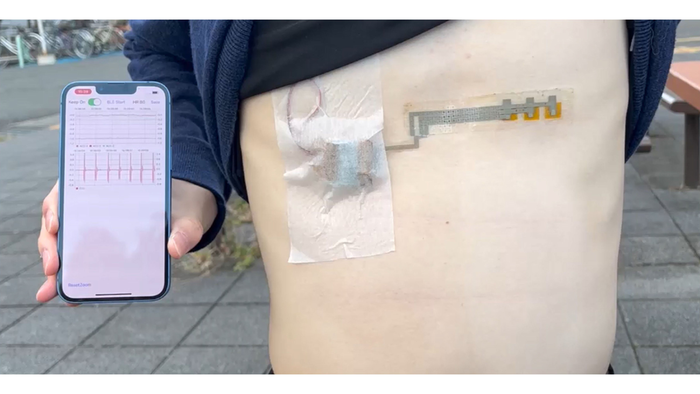
Researchers in Japan are drawing on the principles of centuries-old paper folding technique kirigami to develop a wearable ECG sensor that fits the contours of the body.
The technique, which also involves cutting, allows relatively stiff materials, like polyethylene terephthalate (PET), to adapt to their surfaces.
A small sensor made by a team at Osaka Prefecture University cuts in a film made of PET printed with silver electrodes to fit on a person’s chest to monitor their heart.
Author Kuniharu Takei said:
“In terms of wearability, by applying kirigami structure in a PET film, due to PET deformation and bending, the film can be stretchable, so that the film can follow skin and body movement like a bandage.
“In addition, since kirigami structure has physical holes in a PET film, skin can be easily breathed through the holes.”
The team found the optimal size of the sensor to be roughly 200 square millimetres with a distance of 1.5 centimetres between electrodes.
The size meant they were able to detect enough signal from the heart to link with a smartphone app.
The device could accurately and reliable relay heart data multiple times a day, with readings from multiple people doing many types of everyday movements, such as walking or working while seated.
The researchers now plan to integrate more sensors to measure multiple types of data from the surface of the skin to help early detection of different diseases.
They also plan to conduct clinical trials.
Takei said:
“We understand that the new mechanism or new material developments makes better impact to the field.
“However, without improving the stability, it cannot be used for the practical applications, even if the sensor performance is excellent.”
Image credit: Kuniharu Takei